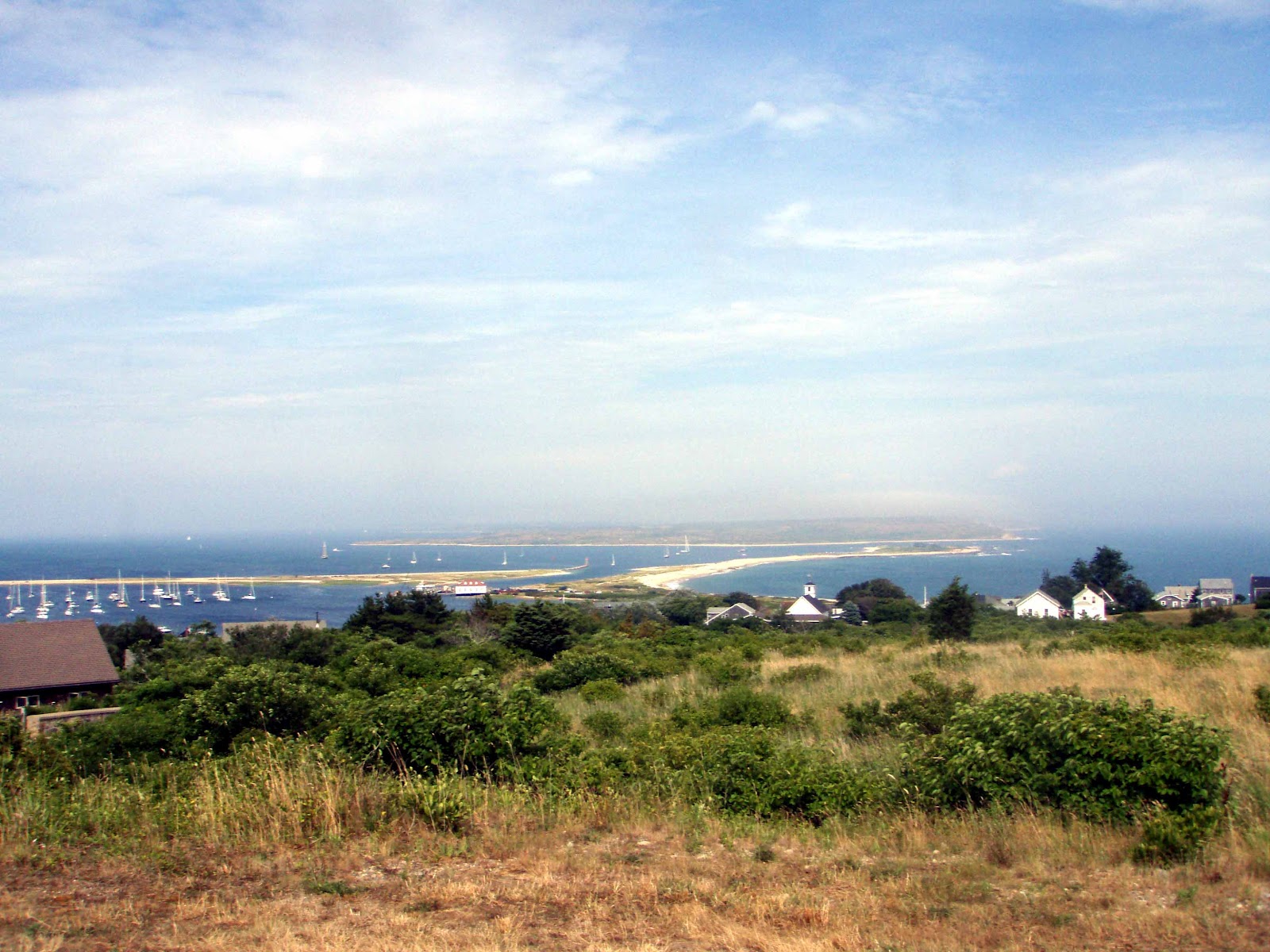
Tuesday, August 7, 2012

Heading Down East


With the outboard back in shape, it is time to depart Newport for Maine.  We do so via a sail up Buzzard’s Bay and an over night at the little village of Onset which anchors the mouth of the Cape Cod Canal.  We need to time our transit through the canal to coincide with a favorable tide.  The water levels in Buzzard’s Bay and Cape Cod Bay can differ by several feet, so the tidal currents are something to be reckoned with.  We do our calculations and appear to have gotten them right as we are accompanied by a sizable contingent of sailboats.  The first sight we see in the canal is the vertical lift railroad bridge, the second largest in the world.  Once a week a train passes over it carrying the trash from the Cape to the mainland; otherwise it remains open at all times.  

Railroad lift bridge on Cape Cod Canal - notice the decorative turrets on the piers


 Along both sides of the canal are bicycle trails and our fleet of boats provides entertainment for those pedaling alongside.  We exit into Cape Cod Bay and proceed towards Provincetown with the wind on our nose and choppy seas. Rounding the hook into Provincetown is a welcome change, and we drop anchor in this large, protected bay.

Provincetown is bedecked with rainbow flags, and we wonder if we will feel out of place here. But, upon stepping ashore, we find the town full of tourists and families, and the diverse populations seem to get along just fine.  At the main pier we find the Kalmar Nyckel, a tall ship representing the state of Delaware.  It is in particularly good shape and, talking to one of the crew, we find they have over 350 volunteers who help with the maintenance and sailing of the ship.  Several of their volunteers are master wood carvers and that becomes readily apparent as the hull is decorated with many whimsical carvings of animals and people.  Along the stern are a row of faces of people who have financially supported the boat, a tradition for ships of that era. 

The wonderfully decorated stern of the Kalmar Nyckel


We take our bikes ashore and wander through tidy cottage neighborhoods with attractive gardens.  Many of these homes are over one hundred years old.  

Home and lush garden in Provincetown


Just outside of town, we pick up an asphalt bike trail into the Cape Cod National Seashore.  One of the nicest trails we have ever ridden, it wanders along the coast, through woodlands, and up and down the steep dunes with a series of hairpin turns and two tunnels. 

A first class bike trail through the Cape Cod National Seashore

View over the high dunes from the bike trail


The trail ends at Race Point, a sand beach rimmed by dunes extending as far as one can see.  We begin walking down the beach and find everyone is gazing out into the water.  Near the shore two seals swim by and further out we see some commotion in the water.  Several large whales have come in relatively close to shore and are putting on quite a show with displays of spouting, tail flips and breaching.  After all, Race Point is the southern boundary of the Stillwagen Banks, the summer home to several varieties of whales. Further down the beach is a restored Life Saving Station.  With the converging currents that formed the Cape and the many shoals off shore, the area is known for turbulent and dangerous waters resulting in numerous shipwrecks. 

Old lifesaving station at Race Point


We head back to Provincetown, passing by the site where the Pilgrims first landed. 
Where Pilgrim feet first touched American soil


Yes, Plymouth Rock was the second landfall for the Pilgrims.  After several weeks of exploring the Cape, the Pilgrims decided that the sandy soil and lack of fresh water made the area untenable for agriculture.  At that point they left to permanently settle at Plymouth.  Commemorating this is a 252 foot high granite monument atop the highest hill in Provincetown. It is the tallest granite structure in the United States.   
So tall, it hardly fits into the viewfinder

And, despite our aching legs from the bike ride, we decide to ascend the tower. Inside the tower are plaques listing the towns where descendents of the Pilgrims reside. Interestingly, many of these towns were originally settled in the 1600’s.  116 stairs and 60 ramps later, we are at the top and enjoying a spectacular view of Provincetown and the Cape stretching beyond it.  

View of Provincetown Harbor from the Pilgrim Monument
Looking down the Cape - it's just really a long sandbar


We depart Provincetown and head out on to the Stillwagen Banks.  After what we had seen off the beach, we are certain we will have some wonderful encounters with whales. The camera is fully charged, and we scan the waters with the binoculars.  Where are the whales? After a while we find a small pod of Minske whales that really look like large dolphins and have none of the more exciting behaviors seen in larger whales.  Later, in the distance we see some spouting and one large whale, probably a humpback or fin whale, actually breaking the surface of the water.  In all, it’s a great disappointment, and we come away without a single picture. 

Our destination, Penobscot Bay, is over 140 miles away, and we will travel through the night to reach it. Shortly before sunset a small cormorant tries to land on our boat.  It is obviously tired and in need of rest.  We would prefer not to have hitchhikers, but when it settles on an arm of the dinghy davits, we let it stay, knowing tomorrow we will need to clean bird poop out of the dinghy. We wonder, does the bird realize it is on its way to Maine? The wind is on our stern, and the wave angle gives us an uncomfortable roll. We finally decide to douse sails and motor the rest of the way, resulting in a bit more comfortable ride.  A heavy fog settles in.  Just at daybreak I see what appear to be two seals welcoming us to Maine’s waters.  But why aren’t they moving as our boat approaches?  At the last minute I realize they aren’t seals, but rather are our first encounter with the feared lobster pots for which Maine is famous.  I shift to neutral and somehow we glide by without wrapping the prop in the lines.  We are still 12 miles from the nearest land and in 350 feet of water – who would expect to find lobster pots out here? For the next six exhausting hours we slowly motor, with automated fog horn blaring, through a maze of lobster pots and erratically moving lobster and fishing boats.  We see absolutely nothing and totally rely on our radar, chartplotter, and AIS to show us the way. We may be in Maine and in Penobscot Bay but who would know?  We work our way into Rockland, and the visibility improves just enough to safely anchor among the other boats in the harbor.

After a long nap, we head into Rockland for their annual Lobsterfest.  This is the equivalent of a county fair with the livestock replaced by boiled lobsters, lobster rolls, lobster chowder, lobster crafts and silly lobster hats.  
Burt gets into the spirit of Lobsterfest - behind him are vats of steaming lobsters

 We wander through the displays and concessions and eventually make our way into the town proper.  Besides its reputation as the Lobster Capital of the World, Rockland is quite an art colony.  The main street is lined with private galleries and anchoring it is the Farnsworth Gallery which houses the largest collection of the Wyeths’ and their contemporaries’ paintings. Unfortunately, it has already closed for the day.  Back at the festival, it is time to indulge in some lobster. Twelve dollars gets you a lobster and all the sides, served under a huge tent as the fog is so dense, it might as well be raining.

By noon the next day, the fog has lifted, and we finally see why we traveled so far.
Penobscot Bay is dotted with wooded islands and rimmed by high hills.  The water is filled with sailboats, many of them traditional wooden schooners and slopes. 

Wooden schooner undersail in Penobscott Bay

 It is indeed a beautiful place and reminds us of our beloved North Channel area of Lake Huron.  And it is to one of these islands we are now headed.  The Seven Seas Cruising Association is sponsoring a Gam this weekend at a private home on Islesboro Island. As we pull into the large harbor, we are greeted by a fleet of DH (Dark Harbor, the name of the small village on the island) wooden sloops. It’s race day, and we pass the starting line just a few minutes before the horn.  After anchoring in a cove, we look back to see all the boats under sail with colorful spinnakers.  We have arrived in time for the Friday evening dinghy raft-up.  Thirty some dinghies tie up behind one boat, and we enjoy greeting new and old friends with the wine and hors d’ouvres in abundance.   
A beautiful sunset at Islesboro Island on our first fog free day in Maine


The next day we go ashore to the host’s home to relax on their shaded lawn, walk through their attractive gardens, and enjoy a pot luck lunch and guest speaker. But, the real intent of a Gam is to renew acquaintances and meet new fellow cruisers.  Here, in this protected outpost of Maine we find more than a handful of cruisers who have crossed oceans or circumnavigated.  Also in attendance are Steve and Linda Dashew, designers of Deerfoot yachts, noted authors of many authoritative books on seamanship and boat maintenance, and multiple circumnavigators.  We feel pretty insignificant in this group. As the twelve foot tide begins to fall, we rescue our now aground dinghy and head back to the boat.  Just before sunset, one of the DH sloops that had been moored next to us yesterday runs ground on a nearby rock ledge. It is painful to watch as this beautiful boat begins to lean to one side, the water getting perilously close to coming over the gunnels.  We worry it could sink or the rocks could puncture its wooden hull.  Boats hover nearby trying to help, but the only solution is to wait for the rising tide.  Come morning, she is happily back afloat and bobbing at the nearby mooring ball – we breathe a sigh of relief.  

The DH sloop sailing past us prior to running aground


We have made it to Maine from the far away Bahamas.  Attending the Gam was the driving force behind our schedule.   Now that we’re here, it’s time to see what lies around the corner.

Tuesday, July 24, 2012

Island Hoppin’


As beguiling as Newport is, we are heading out to explore some surrounding destinations.  First stop is Block Island.  We have been here before via the ferry, but this is our initial experience bringing our boat through the narrow channel into Salt Pond, the major harbor and anchorage for Block Island.  It seems full to us although locals say this is nothing compared to a holiday weekend.  We find a little acreage to drop our anchor and settle in for several days.  We are surprised to discover some friends we made last fall on the way south tied to a mooring and make plans to have them over for Happy Hour in order to exchange stories of our winter adventures.  We also transport our folding bikes to shore for some touring.  Block Island great biking if you don’t mind steep hills.  They’re not a favorite here, but the countryside and vistas are worth the pain.  Towards the north of the island, sand beaches, inland ponds, and rolling hills lead to a lighthouse on a spur of beach.  

The view north towards the Rhode Island mainland


Inland, rock walls, sloping pasture land, cedar shingled homes, and more ponds dominate a landscape that is reminiscent of rural southern England. And, at the south end of the island sheer cliffs sprout another lighthouse. 

Southern coast of Block Island facing out on to the Atlantic


Our son Bryan and his fiancĂ©e, Beth, join us for the sail back to the mainland.  We have a decent breeze, something that has been lacking lately, and we make our way back to Point Judith via a detour almost to the eastern reaches of Long Island. 

The next day we take off for the Elizabeth Islands, a chain which separates Buzzards Bay from Vineyard Sound.  Composed of five main islands, only one, Cuddyhunk, is readily accessible to the general public.  The remainder are owned or controlled by the Forbes family and have been put into a land trust to ensure they are never developed.  And, little Cuddyhunk isn’t exactly a beehive of activity either. We head into the small harbor in a dense fog for which the area is famous.  As the fog lifts, we find ourselves in tight quarters in one of the most compact mooring fields we have ever seen.  Geometry would say that we should be swinging into our neighbors as the light breezes shift, but miraculously we never touch through a somewhat sleepless night.  A hike to the peak of the island reveals a vista with Martha’s Vineyard to the south and the island chain, dappled with wind blown green pasture land and sandy perimeters, trailing off to the northeast.

We're down there somewhere

At the point where the Elizabeth Islands reach towards southern Cape Cod we find the harbor of Woods Hole, our next destination.  The cruising guide indicates anchoring in the harbor is allowed, but when we get there we find it packed with private mooring balls. A call to the harbormaster confirms our fear that there are no transient moorings, but it is suggested that we contact the local yacht club, and, fortunately, they kindly allow us to use an unoccupied mooring.   

The harbor at Woods Hole with funky floating cottages reminiscent of Key West
 
We head ashore to investigate Woods Hole and its famous oceanographic research facilities, but are disappointed to find that most of the buildings are not open to the public.  We attempt to satisfy our curiosity with a visit to a small aquarium and museum.  We must have a disappointed look on our faces as a gentleman who is just passing through the museum engages us in a conversation.  It turns out that he is a retired engineer from the facility, and he captivates us with stories from his career, especially the two voyages he made on Alvin, the well known deep sea research submarine that discovered sea floor thermal vents and mapped the remains of the Titanic. Had we planned our visit to Woods Hole at least a week in advance, it would have been possible to arrange an in depth, personal tour of the otherwise closed laboratories.

Next we head out into the reef strewn Vineyard Sound with its confusing array of currents.  At times we are going over 9 knots and then our speed abruptly drops to around 4 knots, compliments of the swirling tidal currents.  We make our way into the protected and picturesque harbor at Nantucket. It is here that we encounter our first pirates in the form of the smiling mooring field staff that happily collects $75 a night for a mooring ball, an outrageous amount compared to just about anywhere else.  There is no good option to anchor as the huge harbor is full of several thousand transient and private moorings.  We head to shore to find a rickety, overpacked dinghy dock, less than pristine cold water showers, and streets crowded with tourists.  We are not getting off to a good start.  The stores and restaurants are very New Yorkish and very expensive. The docks are full of mega yachts with their uniformed crews milling about. We escape via our trusty folding bikes, through dense traffic, to a paved bike path that takes us to the southern shore and an endless beach pounded by relentless ocean surf.  

Surfside Beach on Nantucket's south shore
 
 Another bike trail and less traveled roads guide us to the outskirts of town where the crowds haven’t ventured.  We find extravagant newer houses with lush landscaping 

A beautiful Nantucket home with the bluest hydrangeas imaginable


and the historic homes of successful whaling ship captains. Obviously, whaling was a profitable occupation back in the early 1800’s.   

Restored federal style homes of the wealthy whale ship captains

 We learn more about this capital of whaling and inspiration for Moby Dick at a museum underwritten by Theresa Heinz Kerry.  Much of the interior of Nantucket is protected public land, and the next day we head out again on our bikes to the eastern shore of the island, pedaling along a paved bike path through rolling countryside that seems a bit barren and wind blown. After all, the Atlantic, with all its wild energy, laps unconstrained at the shores of Nantucket; winters must be brutal here. Our destination is Sconset Beach, a historic cottage community with narrow, oyster shell paths/lanes on bluffs above another endless beach. The restored cottages, many over one hundred years old, and their colorful gardens are nothing short of charming.  

Typical Sconset cottage and gardens overlooking the ocean
 
 We head north out of town on a road along the ocean bluffs to the Sankaty Lighthouse that has been recently moved inshore due to the eroding coastline.  Along the way, we see newer, larger seaside homes, each with manicured gardens.  The style here is to surround the gardens with high pivot hedges interrupted by trellis gates featuring a round opening in the top half, reminiscent of a porthole, which allows a glimpse into the colorful interior. Late in the day, once the day trip tourists have departed for the mainland, we walk along the brick sidewalks and cobblestone streets, through the historic district.  We have to admit, despite the pirates, the ambiance of Nantucket has gotten to us, and we are reluctant to leave. We depart the next morning after a spectacular sunrise over the harbor. 


Sunrise on a still morning at Nantucket Harbor


Our last stop on this circuit is Martha’s Vineyard. We will forego the more popular harbors to join our friends from Block Island in Lake Tashimo.  Just outside of Vineyard Haven, this inland pond has been linked to the Sound by a man-made breechway.  We have been in here before, eight years ago, when we visited these waters with our trimaran.  We remember the entrance as being tricky and shallow in places, but our friends convince us that we can get in on a high tide.  We assume the tide table we have for Vineyard Haven will also be accurate for Tashimo, but when we run aground several times, we discover that is a mistaken assumption.  Fortunately, the soft bottom allows us to free ourselves and make our way into the deeper interior waters.  We will certainly have more accurate tidal data for the trip out! Once anchored near our friends, we gaze out at our lush and isolated surroundings. The shoreline is wooded and dotted with widely spaced cedar shingled homes, ospreys noisily circle above our heads, and swans drift along in the distance.  It is an idyllic setting. The community dinghy dock provides access to the rest of the island.  We head into Vineyard Haven with our friends for a lobster roll dinner at the local Episcopal Church, a Friday night tradition here.  For $15 you get a roll absolutely overflowing with lobster, along with all the trimmings.

The next day is Saturday, and we gird ourselves for a long bike ride.  One town over is Oak Bluffs, and it is the biggest weekend of the year for this community. They are sponsoring a Monster Shark fishing tournament.  With a name like that, you just have to take a peek. Now, Oak Bluffs started out as a Methodist Revival Camp with gaily painted gingerbread cottages, but there does not seem to be much of a Methodist presence today, if the quantity of alcohol being consumed is any indication.   

The quieter side of Oak Bluffs

 While the sport fishing boats are out on the hunt, the harbor is packed with celebrators on boats rafted four to a mooring ball.  You can just about walk across the harbor on all the boats. 

The packed harbor of Oak Bluffs - maybe Put-in-Bay needs a Monster Shark Tournament
 
A paved bike path links Oak Bluffs to its neighbor Edgartown, and we pedal south along a six mile crescent beach. The waters beyond are dotted with sailboats. Edgartown was another haven for successful whaling ship captains and their Greek revival, white clapboard homes surrounded by picket fences are distinctly different from the other island communities. It’s another charming island village, albeit, one ripe with tourists. 

Edgartown's rendition of captains' houses
 
We head back to Oak Bluffs and by this time the crowd has reached a critical mass; the streets and sidewalks are gridlocked.  Through the crowd we glimpse the body of one shark in a cockpit, awaiting the weigh-in, and see another boat with a shark’s tale displayed above the rail.  Meanwhile, a group of protesters demonstrate disapproval of this “slaughter” of innocent sharks. With aching muscles, we head back to a relatively quiet Vineyard Haven and dinner at the well known Black Dog CafĂ©. The sun sets over the harbor, known for its collection of classic wooden boats including the restaurant owner’s two large wooden schooners. It also sets on several huge mega-yachts, including one replete with a helicopter, and a fleet of Corsair trimarans, like our previous boat, in town for a regatta.

The next morning, at a certified high tide, we easily exit Lake Tashimo.  After clearing the western tip of Martha’s Vineyard, the wind picks up, and we have a spirited sail back to Newport. We anchor back at our favorite spot, and shortly thereafter, a huge (over 150 ft. long) sailboat passes by our stern. 


Just another sailing mega yacht cruising Newport Harbor


That night, for some unexplained reason, there is a fireworks display off Fort Adams; we imagine it is in celebration of our return to Newport. Meanwhile, we need to deal with a recalcitrant dinghy motor first thing in the morning. During this last week, it stalls out continuously, and we are getting darn tired of rowing our inflatable dinghy, a real feat if you have ever tried to do so.  Burt attempts every known remedy to correct the problem, but it seems it is now time to call in the experts. Also, we will rent a car to visit Bryan for an evening at his home, investigate rehearsal dinner venues and accommodations for his wedding next year, and seriously reprovision for our upcoming cruise to Maine.

Wednesday, July 18, 2012

Sailing into the Gilded Age


It’s July 4th, and we cross our fingers and head into Newport.  We assume the harbor will be packed and anchorage room extremely limited, but we are surprised to find space still available and score one of the best spots in the harbor for boat watching – just off the main channel and off the New York Yacht Club. Here we notice that Hinckleys far outnumber ________ (insert the name of your favorite production boat). At 44 feet, Exuberant is definitely small potatoes. We have a dilemma as son Bryan and his fiancĂ©e Beth are joining us for the afternoon and evening; do we just sit on the boat and watch the parade of tourist-cruise schooners, historic twelve meter boats from previous America’s Cups, a fleet of Farr 40’s gathered for their North American Championship, and a multitude of mega yachts pass by, or do we hop into the dinghy and explore whatever else is in the harbor? The excitement gets the best of us, and we take a dinghy ride along the circumference of the harbor.  Mansions with their sloping grassy lawns sport traditional day sailers moored just off shore.   

One of many mansions lining Newport Harbor
 
The New York Yacht Club is setting up for a Fourth of July party. 

New York Yacht Club's Newport home - we weren't invited in!
 
Mega yachts are tied up along the way at various marinas.  We actually recognize some of them from our winter in the Bahamas. Back at the Newport Shipyard sailing yachts in the 150 foot range are docked awaiting the summer charter trade.  When we return to our boat, we notice we have a new neighbor, Brillliant, a restored boat out of Mystic Seaport with a crew of teenagers on a sail training adventure.   

Our next door neighbor - Brilliant - out of Mystic CT


That night we are treated to a spectacular fireworks show off of Fort Adams.

While in Newport, we will have our mainsail furler rebuilt and thus will be twiddling our thumbs for a few days before we can get underway again. That leaves us with some time to be tourists.  We stop at the International Yacht Restoration School to check out some of their projects.  Students come from all over the world to spend two years studying restoration techniques for classics yachts. Typically, they work on smaller boats although the school has the restoration of a large yacht underway at most times.  Currently, the Coronet, an 1885 schooner that once sported a piano and marble grand staircase, is being rebuilt from the ribs up.  It will take many years and around $13 million dollars to complete, but from the looks of their previous major project, docked just outside, the results will be spectacular. 

Classic motor-sailer restored by the students and staff of IYRS


We spend part of another day biking along Bellevue Ave., home to many mansions of the gilded age. It’s not hard to envision the Vanderbilts coming along in their coaches or the characters from Great Gadsby playing croquet on the rolling lawns.  Bellevue mergers onto Ocean Drive, and we are riding with the rocky, surfy coastline on one side and large summer homes of the Newport elite on the other.  

A scene from Ocean Drive

At one spot Bretton Point juts out into the ocean, and we stop to watch an amazing display of decorative and stunt kites aloft.  We continue on past rock wall lined farmland dedicated to sheep and horses to Fort Adams State Park, home to the community sailing program, SailNewport, and the site of last week’s America’s Cup Trials. From here, we can overlook the crowded harbor and our anchorage.

We have been in Newport a number of times but never made the effort to tour any of the mansions.  This visit we have the time to do so.  We start with the Breakers, built in 1895 and the summer cottage of Cornelius Vanderbilt.  Some summer cottage – it has 70 rooms, many of which are sheathed in marble and gold leaf.  One room actually has platinum leaf walls. It is beyond ostentatious, but is breathtaking in its opulence.  This is the American equivalent of a European palace, and it doesn’t take much imagination to envision gatherings of Vanderbilts, Roosevelts, Rockerfellers, and Carnegies in its halls, their yachts at anchor in the nearby harbor. 
Burt standing on the front lawn of the Breakers


We also stop at William and Alva Vanderbilt’s Marble House, built in 1892, and modeled after the Petit Trianon at Versailles. It took only two years to complete, an amazing feat considering that vast quantities of marble that had to be imported from Europe for the construction. The massive cast bronze and glass front doors are estimated to be worth $11 million in today’s money. 

Marble House, another Vanderbilt summer home


At the rear of the house, atop the cliffs facing the ocean, is an authentic Japanese Tea House for days when the residents needed to escape the confines of the mansion.  

Japanese Tea House on the grounds of Marble House


Harold Vanderbilt, their son, went on to win three America’s Cups in his sailing career, and the building houses one room dedicated to his trophies and memorabilia.  We are surprised to find that the family occupied the home for only two summers before divorce and other interests shuttered the house.

While we were not able to arrive in Newport in time for the America’s Cup Trials, we will be able to enjoy the Tall Ship Challenge, a gathering of Tall Ships from around the world that cruises the East Coast every three years. One by one, these massive relics of the Great Age of Sail enter the harbor and tie up at wharfs along its perimeter.  The town is packed with visitors for the event, and we choose to stay away from those crowded areas.  After all, we have the ability to view the ships from the dinghy rather than standing in long lines onshore.  The climax of the festival is the Parade of Sail. On the last day the boats head out into Narragansett Bay, form a line to the south, and one by one, under full sail, pass by Fort Adams and under the Bay Bridge.  We head out into the Bay with the dinghy and follow along, getting quite close to these beautiful sailing vessels. 

The Picton Castle and a Trumpy motor launch in the foreground  

The Bounty, built for the movie Mutiny on the Bounty
 
The Pride of Baltimore brings up the rear, and as we are putt-putting next to her, we notice the crew arming the cannons.   

And our favorite, the Pride of Baltimore
 We back off just in time to avoid being in the line of fire as the cannons go off in the direction of Fort Adams.

Newport is a study in contrasts.  We have explored mansions and seen exquisitely restored yachts from the gilded age. Yet, a week ago these same waters hosted some of the most technologically advanced sailboats in the world, battling for the right to participate in the coming America’s Cup.  At the Tennis Hall of Fame, about a half mile away, a professional tennis tournament is taking place on what we are told are the only grass courts still in existence in the United States.  The grounds and façade are modeled after Wimbledon. At the far end of the harbor, super yachts, both sail and power, their value beyond our imagination, are docked awaiting clients or maintenance.  And here we are in our floating home amidst all this beauty, wealth, and history.

Wednesday, July 11, 2012

Hot Times in the Mid-Atlantic


It is hot here in Annapolis.  We spend our time doing laundry, grocery shopping, and some boat repairs.  You move slowly when the temperatures often go over 100 degrees. Yet, we do find some time and energy to be tourists. We take an opportunity to tour the William Paca House and gardens. This beautifully restored Georgian home dates back to 1765 and was the residence of one of Maryland’s signers of the Declaration of Independence. The formal gardens cover over two acres and have intrigued us as we glimpsed over the high brick walls on previous visits to Annapolis.

Gardens at the Paca house

 
No trip to Annapolis would be complete without a stroll on the Naval Academy grounds.
This time we chose to take the official guided tour despite the overbearing heat.
Unfortunately we get the tour guide who thinks it is just fine to talk at great lengths in the glaring sun rather than in the air conditioned buildings and shaded grassy areas.  That aside, the Academy has some impressive buildings, and it is interesting to hear about the life of a mid-shipman, especially since the Class of 2016 was inducted just the day before amid great ceremony and a Naval jet fly-over.  All four years’ worth of students are housed in the huge Bancroft Hall, portions of which are open to the public.  We see a typical dorm room, the huge marble entrance rotunda, and peek into Memorial Hall which features John Paul Jones’s “Don’t Give up the Ship” flag.  Until last year the original flag, over 200 years old, hung there, but now it is displayed in a controlled environment in the Naval Academy Museum and a replica hangs in its place.   

Looking up at Memorial Hall - not a typical scene for a college dorm!
 
We stroll over to the Chapel which is just about to close.  The interior is ornate and features stained glass windows by Tiffany.   

Sanctuary and alter at the Naval Academy Chapel


Unfortunately, the crypt of John Paul Jones, under the sanctuary, has already closed.  Just across the street is the air conditioned Naval Academy Museum, so we go inside to recuperate. It proves to be an interesting stop with the first floor featuring naval history and the second housing a huge collection of model ships.  Prior to the days of CAD drawings, ship designers used detailed models to assist shipyards, and we see many such models, some of which date back to the 17th century.  Also there is a display of remarkable ship models made by French prisoners of war constructed entirely of carved bone fragments that came from their meat rations.

Did I mention that it is really hot in Annapolis?  On our last night there we move from Spa Creek where there is nary a breath of air and pick up a mooring ball in front of the Naval Academy.  To our surprise the boat next to us hails from Wooster, Ohio; we had met this skipper three years ago at the same location.  Just before sunset, the water taxi comes by and mentions that there are some severe storms headed our way.  We pass the warning on to our neighbors and then secure things on our boat.  Well after dark the storm hits with a vengeance, knocking the boat on her ear.  At one point during a lull I glance at the wind speed indicator and see it is in the mid-40’s.  Who knows how hard it was blowing in the gusts – we were too busy hanging on.  After it passes, things cool down a bit, and we enjoy a pleasant remainder of the night, leaving at first light the next morning for the trip up the Chesapeake.  From our perspective, all have fared well.  Little did we know that all across the mid-Atlantic and as far west as Ohio, electrical grids are down and a number of people have died in this freak storm of almost hurricane strength straight line winds.

The motor up the Chesapeake is hot but uneventful.  We time our arrival at the D&C (Delaware and Chesapeake) Canal to coincide with a favorable tidal current, and we plan to stop half way through at a marina where we will plug in for air conditioning.  But, alas, with full moon tides it is too shallow for us to enter the basin, so we proceed out into the Delaware River/Bay and drop anchor a couple miles further at one of the few viable anchorages along this route.  It is hot, hazy, and dead still, but at least we have a safe place to spend the night.  The next morning we continue motoring with a favorable current.  The Delaware is not one of most people’s favorite places; there are few interesting sights along the way and it is full of commercial traffic that hogs the narrow channels. 

You definitely stay out of the way of these big guys
 
Fifty miles later we come to Cape May and the entrance into the Atlantic Ocean.  As if on clue, a nice breeze picks up, and we sail the last hour around the Cape and into the protected harbor. Here we have reserved a slip at what proves to be the most expensive marina we have ever visited.  With temperatures hovering around 100, it is worth the expense as we will have air conditioning for the night. 

Cape May is an interesting place and probably the nicest resort town on the Jersey coast.  The commercial fishing fleet is housed right next to our marina and in front of a locally famous restaurant, the Lobster House, where the seafood is unquestionably fresh.  

The fishing fleet congregated next to our marina

The next morning we bike through the town, admiring the attractive Victorian homes and several mile long beach.  It is very tidy and definitely not honky-tonk. 

Victorian homes across the street from the ocean side boardwalk
  
We leave Cape May in mid-afternoon, thinking we will arrive in Rhode Island about 40 hours later.  Another boat in the vicinity is making the same passage so we stay in communication via VHF radio, giving us a feeling of security along with some interesting conversations during long night watchs.  Somehow we have mis-calculated our travel time; we are seeing some wind for sailing the first few hours and after that we get a favorable current.  Our buddy boat travels even faster and arrives at Block Island just at sunset.  It’s July 3, fireworks are planned for the evening, and they radio back that the anchorage at Block Island is jammed.   We decide to continue on to Point Judith Harbor of Refuge rather than risk entering a crowded harbor in the dark.  As we pass by Block Island, we see the fireworks display and the fireworks of Narragansett in the distance.  Welcome to New England! It’s much cooler here, and, after 32 hours underway, we drop anchor in the Harbor of Refuge under a full moon just before midnight.  The next morning we have a brief motor into Narragansett Bay and the always charming Newport.

Monday, June 25, 2012

Back in the Saddle Again


It has been a long and arduous month in Deltaville.  Living on the hard – that is, living in the boat while it is on jack stands in a boat yard - is about as unpleasant as it can get.  You have limited water and electricity, and no toilet facilities.  That means middle of the night trips to the bathroom require getting dressed, descending an extension ladder, and walking or riding a bike in the dark to the marina facilities.  Boatyards are dirty, dusty places, and all that crud gets blown or tracked into the boat.  And, finally, in 90 degree temperatures, the hull heats up fast and becomes an oven for those inside.  During this time, the boatyard removes 20 years of bottom paint, re-fairs the hull, and applies multiple coats of barrier and antifouling paint. They discover our cutlass bearing is failing, so that is replaced along with new engine mounts.  Meanwhile, we are hard at work rebedding two fixed windows and one genoa track, varnishing various interior and exterior wood pieces, servicing winches, cleaning and re-stitching the genoa, and sewing UV covers for all the jerry jugs and fuel tanks we carry on board. Once the work is completed, some serious cleaning is in order.  Tempering this is the fact we are in a pretty location with nice marina facilities and many pleasant people to share our few hours away from the grind stone.  And, finally, we do take ten days to travel to Ohio and Wisconsin to visit family and friends.

But now we are happily afloat and heading north.  We plan to spend about a week slowly making our way to Annapolis, stopping along the Bay at spots recommended by long time Chesapeake cruisers.  Our first stop is less than ten miles from Deltaville, in Irvington, VA. The town sits on a creek on the north side of the Rappahannock River.  It is home to the Tides Inn, an exclusive resort, and numerous beautiful waterside homes. 

Nice setting along Irvington's waterfront


It is also home to zillions of osprey that make their nests on top of every decked pole and inside every channel day marker. 

And a happy home for an osprey


We chill out on the boat, disinterested in even heading ashore, as the wildlife, views, and sunset are what makes the place so charming.

The next stop is just a bit further up the Rappahannock at Urbanna, an historic town dating from the Revolutionary war era.  It’s a quiet place with little to offer except two beautiful, privately owned estates dating from the late 1700’s 

Historical home in Urbanna


and a general store from the late 1800’s which features rolling ladders for the upper shelves that sport “Made by F E Myers, Ashland, Ohio”. Ah, so far and yet so close to home.

Look hard and you'll see the FE Myer's inscription


Next we travel across the Chesapeake to the eastern shore and the town of Onancock. It is a several mile motor up a rural creek to the town and our anchorage just off shore.  This is one of the nicest towns on the eastern shore with mostly century homes that are well maintained and have beautiful gardens.  

Home with hydrangeas in Onancock


 It’s a gentrified sort of place with upscale restaurants, antique shops, and even a knitting store that fills my longing for some hand work.  At the far end of town is a large mansion, built in 1799, that now houses the Eastern Shore Historical Society. 

Home of the Eastern Shore Historical Society


It is past closing but the director still invites us to take a quick peek as they are preparing for an event later in the evening. We wander around the beautifully restored main floor and are surprised to find a Gilbert Stuart portrait of George Washington hanging in the dining room.  We enjoy a dinner on the waterfront and meet another boat of cruisers who later email us this remarkable photo of Exuberant at anchor on a very still morning.  


It’s off to Tangier Island, an unusual and very authentic destination that we visited several years ago. Tangier is home to a tight group of loyalist families that have maintained a very traditional life style and a slightly different dialect of speech.  The locals mostly have last names of Parks, Crockett, and Pruitt; very few outsiders take up residency here. Physically, it is a maze of guts (shallow and narrow creeks that often dry at low tide) and creeks through marshes of tall grasses. A long point of sand dunes extends south from the island.  

Several miles of beautiful beach at Tangier Island


Herons, ibises, and osprey abound. The only industry here is fishing and crabbing with boats of all sizes far outnumbering golf carts or bicycles; cars are totally superfluous. 


It is the home of traditional Chesapeake watermen, and our small marina is owned by Milton Parks who made his living for 60 years from the sea.  He is a wealth of information and tales (perhaps some of them tall) about the island.  It is also the home to many cats. 

Only four cats where there used to be at least a dozen

 Rumor has it that the Virginia Humane Society made an effort to spay and neuter the population, but the local residents took umbrage with the interference and hid some of the cats when the vets showed up.  The authorities must have had some success, though, as we were tripping over cats three years ago, but now they seem merely plentiful.

We zig zag back across the Bay to Smith Creek which is just inside the mouth of the Potomac River.  The Bay is like glass and we see numerous skates (relatives of rays) hunting in schools near the surface of the water.  We wander up the creek through a rural setting to a marina.  It is very hot, and we are desperate to plug into electricity to run our air conditioning.  Unfortunately, one unit is not working; we apparently clogged the water inlet with huge quantities of sea grass while at Tangiers. The only solution is to take a long soak in the marina pool, and then eat dinner in the adjacent, air conditioned restaurant.  Again, we have found a very quiet and picturesque area that seems to be typical of the Chesapeake shore.

The next hop is a long leg up to Galesville, MD, again motoring in still water.  This is where we launched the boat last fall after the Hurricane Irene fiasco.  It seems fitting to return, but we also want to visit with friends we made during our Bahamas cruise who permanently dock here. We have a pleasant alfresco breakfast with Vickie and Mike, but they warn us that this will not be a quiet Saturday night in the typically quiet Galesville.  A group from Annapolis is coming down for their annual raft-up that includes two live bands playing on the back deck of a large power boat.  Mid-day the boats begin filing in, and we watch with fascination as they raft up a short distance away.  Kids are in swimming; adults are floating along on water toys.  At 6:00 the music starts amidst a progressive Happy Hour and dancing on back decks.  The featured band is the Tiki-Barbarians, and they are actually pretty good.  

The Tiki Barbarians entertain the crowd


We join the many dinghies that float in front of the raft-up for a close up experience, and rejoice that the music stops at a civilized 11:00 pm. It’s just another of those sublime experiences you have while cruising.    

With the apparently broken air conditioning unit, a dinghy that is hiccupping, and a replacement head awaiting us at West Marine, it is time to leave for Annapolis where boating services and supplies are readily available.  We pick up a mooring ball just off the Naval Academy for the night.  It is a Sunday, the Bay is alive with boating action, and we have front row seats. 

Annapolis waterfront from the mooring field


The next morning we move into Spa Creek to anchor near our friend Stan Mathey, fondly known by the locals as the Mayor of Spa Creek.  Stan used to dock near us in Sandusky but now is permanently in Annapolis. Amazingly, just after calling the air conditioning repair technician, the unit miraculously comes back to life.  We will spend a few days here attending to other boat repairs, reprovisioning, and planning our next leg of the voyage where we will make our way down Delaware Bay into the Atlantic and on to New York City.  Meanwhile, our weather service is hinting that Tropical Storm Debbie may grow into a strong hurricane and head up the Atlantic coast.  Once again, weather issues may impact our plans.