Thursday, July 11, 2013

Cruising in Southern New England


Currently, it is not the best time to be cruising in New England.   A low pressure trough has parked itself along the eastern seaboard providing a menu of humidity, drizzle, fog, and thunderstorms in no specific order.  Every couple of days we get a brief period of pleasant weather, but, like clockwork, the dismal funk returns. It has been over a month since any significant weather front has passed through, and a good cold front is what we need to change this pattern.

Meanwhile, we make the best of the situation. Port Washington provides an opportunity to shop at a huge grocery store with its own dinghy dock, quite a memorable find. After we are rejuvenated, we head further east to Oyster Bay on Long Island.  
 
One of the swank yacht clubs at Oyster Bay

And the hundred and some foot yacht from the Netherlands anchored just off the yacht club. Boats this size need to have a red light at the top of their masts to warn low flying aircraft.

This is the upscale location of Theodore Roosevelt’s home Sagamore Hill. Teddy was an interesting character, and I am anxious to visit this National Historical Site.  We tie the dinghy along a seawall and walk up a steep road to Sagamore Hill.  Unfortunately, the house itself is closed for renovations, but we are free to stroll the grounds and visit an informative museum. 
Sagamore Hill under renovation for the next several years

While Roosevelt was president, he greatly expanded the Navy.  Once the fleet was complete, he had all the ships painted white (a sign of peaceful intent) and arranged for them to sail around the world on a good will mission. Prior to leaving, he reviewed the Great White Fleet as it sailed into and anchored in Oyster Bay. Now, Oyster Bay is relatively small and the fleet was huge, so it is hard to envision what a spectacle that would have been.

Next stop is a friend’s mooring in the Thimble Islands on the Connecticut coast just east of New Haven.  It is tricky navigating through the rocky islands and ledges in the growing fog.  We find the mooring and decide to remain on the boat rather than launch the dinghy and explore – it has started to drizzle and we enjoy the surrounding views just fine from our cockpit.  The Thimble Islands remind us of the Bay of Islands in the North Channel of Lake Huron.  Each pink granite islet sports a home of varying size from small cottages to outright mansions.  One very wealthy family is in the process of buying up all the available islands.  If you see a flag pole topped with a shamrock flag, it indicates that property is part of the family’s holdings, and there are a lot of shamrocks to be seen.  It is a quaint and, with the fog, mystical place to spend a night.
Foggy Thimble islands with a house sporting a shamrock flag in the background


We move further east to Groton/New London where both our son Bryan and his fiancĂ©e, Beth, work. Again, it is foggy and at times very rainy. As we motor past Bryan’s office building (the former world headquarters for Pfizer), he and his office mates claim to be in the windows madly waving at us.   
Bryan's office - we're too far away to see everyone waving

We take a New London municipal mooring and meet up with the kids for dinner on the town.  We find a decent restaurant, but New London seems a bit rough around the edges, and we leave the next morning.

In contrast, our next destination, Newport, is anything but rough around the edges.  As we work our way into the harbor, we pass the historic yacht Ticonderoga heading to the ocean.  Interestingly, we met the grandson of the original owner this past winter in the Bahamas. 
Ticonderoga motors past us with one of the Newport mansions in the background

Newport is already packed in anticipation of the fourth of July, and we can only find anchoring room just north of the harbor, making for a long dinghy ride into the cruisers’ facilities.  But, the ride requires we pass by the docks of the world renown Newport Ship Yard. Each day the collection of mega yachts and race boats changes.  Rambler, the boat that blew away all the competition in the recent Annapolis to Newport race, is there for a few days. Two restored motor yachts (vintage 1910’s) over 100 feet long are tied up. A slew of charter mega sailboats that work the Caribbean in the winter are docked.  We see a new ketch around 150 feet long, that is being commissioned, docked on the outside.  With very traditional lines, it sports gorgeous varnished wood cabins, carbon fiber masts and booms, and the ultimate in high tech rigging.
Traditional lines plus high tech engineering equal a real knockout
Varnish work that requires sunglasses


 And, out in the harbor on a mooring is one of my favorites, Whitehawk, a beautifully restored wooden ketch.   
Whitehawk on her mooring in Newport

Yes, if you are a boat aficionado, Newport is the place to hunt eye candy.  We stay for several days, enjoying the parade of boats and fireworks on the fourth, and then are joined by Beth and Bryan for a daysail down the bay and more fireworks from Jamestown across the bay. 
We are trying to race against this modern rendition of a traditional schooner, heading into the Newport Shipyard. Needless to say, we were creamed.

Newport is definitely one of our favorite cruising stops!

The holiday is over and the crowds have left, so we make our way over to Jamestown, where it isn’t so busy, to refuel, and then have a lovely sail, beating to windward to Block Island.  It may be hazy, but there is no fog or rain, and we are totally enjoying the ride. Salt Pond (New Harbor) is mostly filled with mooring balls, but we are able to find a niche in which to anchor.  We immediately launch the dinghy and find our friends on Amici who are anticipating our arrival.  It doesn’t take much arm twisting to convince them to join us at the local watering hole, The Oar, for a mudslide, a Block Island tradition that confirms we have arrived. As we are anchored near the harbor entrance, we enjoy watching all the boats come and go.
Brilliant, Mystic Seaport's restored training boat, hoists anchor while under sail and leaves a very foggy Block Island

We visit a nearby beach, Burt does some biking (I have torn something in my leg and am on injured reserve), and we socialize with friends, but the weather is mostly foggy and rainy, limiting our enjoyment of this lovely island. 

A front is forecasted to come through tonight, and we are hoping that will clear out the nasty weather and end our month of “funk”.

Friday, June 28, 2013

Back in the Saddle Again and the Passage from Hell


Not much exciting happens during our time in Galesville. We arrive and spend several days at a dock preparing to pull the boat, and then the big day comes when the boat goes in the slings and on jack stands.  She always looks so ungainly swaying in the hoist. 
Going on to the hard (with our fingers crossed)

Burt makes arrangements for yard workers to varnish our companionway steps, touch up a few spots of bottom paint, and replace the zincs.  Here in Galesville we are not allowed to do any work ourselves while the boat is on the hard.  Meanwhile, we get a rental car and take off for Ohio and Wisconsin to visit family and friends.  It’s a pleasant two weeks of shore leave for us.  When we return, it is back to the grindstone.  The boat is launched, and we spend two weeks finishing up our chores.  The deck and cockpit are cleaned and waxed.  Exterior canvas is removed and cleaned of its accumulated mildew. More interior varnish work is completed by Burt while I refinish the boarding ladder. The interior cupboards are all emptied, cleaned, and reorganized, and interior walls and floors get a good scrubbing. We take advantage of the car and do extensive shopping and reprovisioning. After all, a year of laundromats takes its toll on our clothes.  Our monthly dockage and car rental runs out, and that is the signal that it is time to move on.  Boat chores are endless, so it is nice to be forced to stop. All is not misery in Galesville, though.  We meet up with several cruising friends in the area for dinners out and make new friends who are permanently docked in Galesville.

Upon leaving the dock, we make a huge passage of about 1/8 mile to the anchorage at Galesville.  Here we have arranged to meet up with our Australian friends with whom we cruised extensively last summer.  They are on their way south to have their boat pulled in the lower Chesapeake while they head back to Australia for three months. Fortunately, our paths cross, and we enjoy a relaxing dinner with Claire and Andrew on Exuberant.  Talk goes late into the night as we have a lot of catching up to do. The next morning we part ways, they heading south and we heading to Annapolis – who knows if and when we will next meet.

We treat ourselves to four nights on the mooring balls in Annapolis.  It is truly special to be moored off the Naval Academy and the historic harbor.   
Just as our neighbor's boat says, the moorings in Annapolis are serene

We watch traffic come and go; racing fleets head off for evening contests, large yachts come by on their way to docks, and interesting boats tie up on the balls.  One such boat was a wooden pilot boat built in the 1930’s that had been in service on the Columbia River and then in Alaska.  It had been partially restored at the Shannon Boatworks in Bristol, RI and now was on its way home with new owners who intended to complete the restoration.   
A study in contrasts - the wooden pilot boat in the foreground and a mega-yacht behind
We have dinner one night with friends Kathy and Curt who we met in the Bahamas this winter.  Although they have lived aboard their boat for seven years, this was their first year out cruising, and they are an example of Murphy’s Law at work.  It seemed everything was breaking on their boat during the winter, and when they finally arrived in Annapolis this spring it was discovered that they had taken a near lightning strike.  Now they are on the hard having fiberglass repaired and electronics replaced.  During it all, they have maintained an optimistic outlook, and we hope to meet up with them later this summer in New England. We also have an opportunity to meet up with our friend Stan who originally docked just down from us in Sandusky.  He now works for the Annapolis Harbormaster, and, as typical, keeps us in stitches with stories of what he witnesses in the harbor.

But, it has been hot and humid in the Chesapeake, and it is time to head further north.  We have a leisurely motorsail to the north end of the Chesapeake and the peaceful Bohemia River. It marks the entrance on to the Chesapeake and Delaware Canal.  You time your departure for the canal to coincide with favorable tidal currents both in the canal and Delaware Bay – Burt describes it as dealing with simultaneous equations as the timing is so tricky.  Thus we anchor for the night and in the early morning prepare the boat for what will eventually be an ocean passage.  The dinghy, now filthy with Chesapeake growth, is raised to the foredeck and then scrubbed – there goes our clean decks.  We rig jacklines and a radar reflector.  
Burt at work - jacklines, check; radar reflector, check; dinghy on deck, check

At the appointed hour we pull anchor and head to the canal.  Right behind us is s/v Ladyhawk, a boat we met a year ago in the Bahamas.  They are on their way to Nova Scotia, so we will have company and radio conversation for the passage.  At this point, we begin the “Passage from Hell”. It has gotten deathly hot and humid, and what little wind exists comes from our stern, leaving us with no cooling breeze.  When we arrive at Delaware Bay we turn south and finally get a beam breeze which makes things more comfortable, but also brings flies by the gazillions.  We are besieged, and the human versus fly war is instigated while we motor sail down the Bay, maintaining enough speed to keep in a positive current.  At times we see over ten knots, but there is little opportunity to enjoy the ride as we are too busy swatting flies. At dusk, we round Cape May and endure a few hours of uncomfortable waves against current; we’re still swatting those darn flies. We finally put up screens to surround the cockpit, but there is major carnage below decks, and it is hard to sleep while being bitten. Dawn arrives and the captain and first mate are groggy and irritable, as it seems the flies below are multiplying while the cockpit screens are covered with flies hitching a free ride north. As we close in on the entrance to New York Harbor, we pump our holding tanks overboard where it is legal. But, they don’t seem to be pumping correctly, and there is an unpleasant smell.  A look below at the pumps proves that both have suffered membrane failure, and we have managed to spray holding tank contents into the cabinets under the head sinks.  The flies are having a field day, and we are considering scuttling the boat. We pull into Sandy Hook, drop an anchor, and discuss our limited options.  Burt has one spare pump (Who would ever think you would need to carry two spares!) so he replaces one failed pump after cleaning and sanitizing the cabinets. Meanwhile, as I store all my cleaning products in the contaminated cabinets, I remove the contents and clean and sterilize them on deck.  We are filing garbage bags with disgusting stuff from our perspective while the flies feel they have died and gone to heaven with the odorous scent; it appears they have decided to take up permanent residence on our boat.  It is late when we complete the unpleasant tasks; we have a quick dinner and collapse into bed, proving if you are tired enough you can even sleep while the flies bite. Severe thunderstorms are passing nearby and tomorrow we will head through Hell’s Gate on the East River. But, somehow, it seems like we’ve already been through the gates of hell.

The next morning with flies buzzing outside the cockpit and corpses littering the interior, we pull anchor and head into New York Harbor with a favorable current but also with dense fog. There is so much traffic that it is hard to keep track of all the boats with the radar and AIS while we continue to swat flies.  All of a sudden as we are approaching the Verrazano Narrows Bridge we hear a loud horn from behind. We are startled by a huge container ship bearing down on us, and we rapidly move out of the channel.   

A foggy encounter with one of the Big Boys as we go past the Verranzo Narrows Bridge
The fog lightens as we approach the City, and we get views of the Statue of Liberty and lower Manhattan.
The Statue of Liberty with one of the ever present Staten Island ferries

Manhattan skyline as the fog lifts

With four knots of positive current we fly through the East River, enjoying the exhilarating experience of sailing through one of the most impressive cities in the world. By lunchtime we are tied to a free mooring at Port Washington on the western end of Long Island.  Here we will pick up a second pump at a nearby West Marine, and best of all, get rid of our stinky garbage.  With a decent breeze and severe thunderstorms again bearing down on us, the flies decide to leave for shore and the human versus fly war comes to a draw.  Sure, there is clean up to be done, but we no longer smell and can sleep in comfort.

Monday, May 20, 2013

End of the Road (for now)


It is an easy trip from Vero Beach to St. Augustine on the ICW, taking three days with two nights at anchor along the way.  This is northern Florida where large homes and water front communities are interspersed with nature preserves.  You can go for miles in the company of dolphins, birds and manatees without seeing any development.  The ocean is often just over the dunes to the east.  In all, it is a pleasant experience, reinforced by the knowledge that the current sea conditions in the Atlantic Ocean make that a less desirable alternative.

We reach St. Augustine early afternoon and launch the dinghy so that we can enjoy a brief visit to this historic and attractive city.  To celebrate our last night in Florida, we have dinner at a nearby restaurant with friends we know from the Bahamas.  They are in St. Augustine to store their boat for the summer.  And this isn’t too unusual as our group of Bahamas cruisers are falling by the wayside, most storing their boats in southern locations.  We are in the minority as full time liveaboards, heading as far north as possible. 

After dinner, it is time to prepare the boat for the offshore passage.  The dinghy is secured to the deck, jacklines installed, and the engine gets a thorough check up.  The weather for our passage is looking favorable, and we will leave at first light in the company of friends on another sailboat who are veterans of two circum-navigations and one trip to Europe and back.  It humbles us when we encounter such people. 

The next morning is beautiful, and we head out into the Atlantic with a parade of boats.  Most will peel off somewhere along the coast for shorter hops, but our two boats are determined to make it all the way to Beaufort, NC. The waves are almost non-existent, the sky is blue, and we begin a long motorsail northward. We will be at sea for three days and two nights.  One truism of sailing is that if anything will go wrong, it will happen at night.  This proves to be the case for us.  In the middle of our first night out, while I am on watch, the prop suddenly begins to make a very ugly noise, actually shaking the boat.   In a panic I shift to neutral and the noise stops.  Burt comes on deck, and we think through the situation. There seem to be two possibilities; either the zinc on the prop has come loose or we have hit something that perhaps is tangled in the prop.  We cautiously put the engine in reverse – no ugly noises.  Then we try minimum RPM’s in forward and still no ugly noises.  We eventually get the nerve to go back to cruising speed and everything is operating just fine.  The downside to bump in the night events is that your adrenaline is now sky high and neither of us gets much sleep for the rest of the night. We will hire a diver once we get to Beaufort to verify that nothing is wrong below the waterline.

Things go just fine until the following night.  Just after I begin my watch, I see flares going off in the distance.  I call over to our buddy boat and ask if they have seen anything, but they were below at the time.  Over the next few minutes several more flares go off.  I take note of our position at the time and take a sight bearing in the direction of the flares.  We are about 50 miles off the coast and barely in range of the Coast Guard when I call in our observations.  More flares are going off while I answer what seems to be hours of inane questions, often relayed by our buddy boat since they are receiving the radio communications better than we are.  At the same time, another boat, perhaps 20 miles away from us is also reporting the flares and with their position and sight bearing, it seems the Coast Guard could figure out the location of the activity.  But, the poor soul on duty that evening is having some difficulies.  Finally, hr requests that we alter our course and begin a Search and Rescue Operation.  I am not too thrilled about this as we have no idea how much further offshore we need to head, but we comply with the request.  After all, if we were the boat in danger, we would hope others would be willing to come to our assistance.   It all ends when the Coast Guard contacts us again with the news that the flares we have been seeing are actually a naval training exercise.  We are amazed that it took over a half an hour to identify the source.  We go back to our intended course, but it is another night where adrenaline is pumping and again we get little sleep.  We pull into Beaufort around noon on the third day after covering 384 nautical miles in 58 hours.  We are exhausted and splurge on a dock along the town waterfront. 
Burt relaxes in the hammock-chair along the Beaufort waterfront


Now, we shy away from docks due to the expense. We actually have not been at a dock since we checked into the Bahamas in Nassau in early February. But, this time it appears it will be an interesting and enjoyable experience.  We are told to pull into the slip next to the sailboat with the 100 foot mast. It doesn’t take long until we meet the captain and crew of our neighbor, an Oyster 72 out of England.  They are the paid crew, a husband and wife from Britian and the Netherlands, respectively, and now residents of British Columbia.  They are friendly and are looking for some company for the evening. We make arrangements to join them for a drink and dinner ashore and include the couple on our buddy boat. It makes for an interesting conclusion to the day as our companions have sailed all over the world.  We listen spellbound to what they have done and experienced and stop for a cup of expresso on the Oyster before calling it a night.  As the evening ends, we find that all of us have cruising friends in common.  In the sailing community seems to exemplify “one degree of separation” with those we encounter, and we plan to stay in touch with this interesting couple.

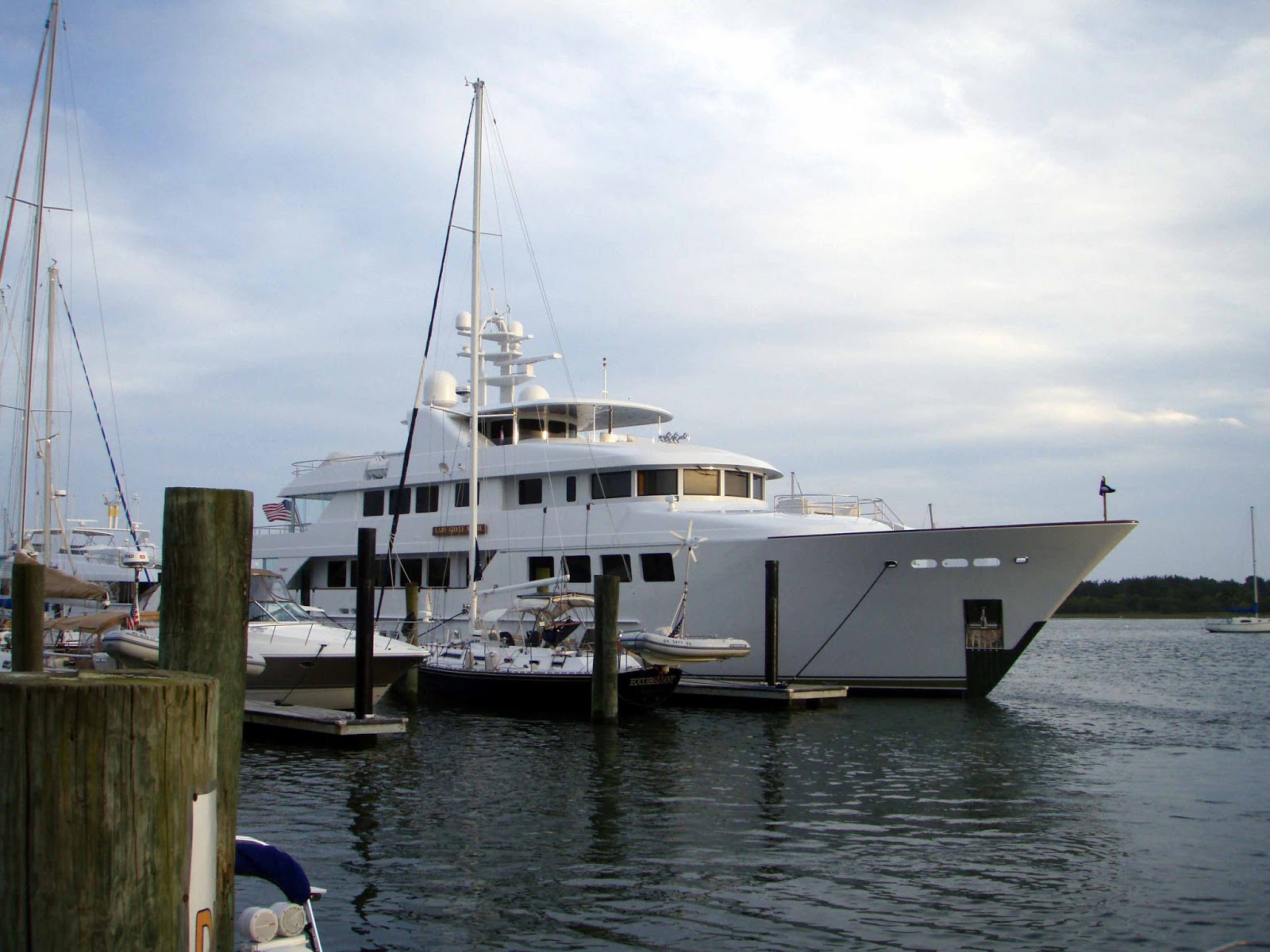
The next morning the Oyster leaves as they are making an ocean passage all the way to Maine where the boat is undergoing six weeks of maintenance.  In its place a 146 foot motor yacht pulls in, and we now are looking out at a very BIG white wall. It appears things will remain interesting.  Again, this is a delivery crew, also taking this boat up to Maine.  Once the boat is docked and cleaned from top to bottom by the large, uniformed crew, the captain stops by to chat.  He is retired from the Coast Guard, and this is his full time job. The boat winters in Florida and New Orleans (we suspected that when we saw a Saints Super Bowl Flag on the bow staff) and summers in Maine where the owner uses it for about six weeks in June and July, before he heads back to work in August.  And why would he need to be at work in August?  Perhaps, because he is the owner of the New Orleans Saints and a pro basketball team.  Sometimes the wealth we observe is astounding. 
Laady Gayle Marie docked next to our tiny boat


Once we have gotten some well deserved sleep and are done gawking at our neighbors, we take the dinghy to do some exploring around Beaufort.  The small town sits on the mainland and is separated from the ocean by a series of barrier islands that are part of a national seashore.  We take the dinghy to one of the islands and go on a hike.  But we see little; our eyes are glued to the foot path as we try to avoid large piles of horse manure. You see, these islands are all populated by herds of wild horses.  We dinghy to another section of the island where we find some of the horses knee deep in water, grazing on the marsh grasses.  
Wild horses grazing in the marshes

Marsh land separating the numerous barrier islands
 The area is named the Rachel Carson Wildlife Preserve in honor of Carson’s years spent studying the ecology of the area. 

Later that afternoon we venture over to the annual Beaufort Music Festival, just down the waterfront from our dock. While we can hear the music on the boat, it is fun to mingle with the crowd.  A variety of North Carolina groups are featured during this two day event.

We would love to stay in Beaufort, one of our favorite coastal towns, but we are on a tight schedule.  North winds are predicted so we will make the remainder of the trip to the Chesapeake on the ICW instead of tempting fate along Cape Hatteras. We spend three days motoring through sparsely populated swamp lands.  There are few towns along the way and almost no cell phone service.  We anchor alone in remote locations for the two nights underway before heading into the Norfolk area that bustles with activity.  There we dodge commercial and military traffic, and transit a lock and many opening bridges on restricted schedules, thus making this final leg to the Chesapeake a bit slower. 
The USS Comfort docked at Norfolk, a symbol of America's generosity around the world

One of the large aircraft carriers with a jet visible on the deck

Once free of Norfolk, it is time to unfurl the sails and head north up the Bay. Our first night’s anchorage is at Deltaville where we spent a month last spring doing maintenance.  
The serene anchorage at Deltaville

 The next night we pull into Solomon’s Island, where in previous visits we have anchored in an adjacent creek.  This time we decide to take a mooring ball for two nights and explore the town. The place is full of marinas and boatyards, probably because it provides easy access to the Bay for Washington, DC residents.  There are a few bars and restaurants along the waterfront, and right next to the mooring field is a very nice maritime museum which we visit.   
The maritime museum at Solomon's Island with its iconic screwpile lighthouse

That night the museum is sponsoring an outdoor concert, one of their major fund raisers for the year, featuring A Band Called Perry, a nationally known country band.  Five thousand fans have purchased pricy tickets, but we sit on the back deck of the boat enjoying the music and light show for free.  Yes, it is not quite as loud for those of us on a mooring, but that’s just fine by us.

One last breezy and rainy sail brings us to Galesville, MD and the Hartge Yacht Harbor.  Here we will pull the boat, leaving it on the hard while we head back to Ohio and Wisconsin to visit family and do annual doctor checkups.  We have routine maintenance, varnish work, serious cleaning and polishing, recertification of our life raft, and installation of a new autopilot to accomplish once we return. So, it will be about a month until Exuberant is back underway and heading further north. We reflect back on our recent travels – not counting the days spent waiting for acceptable weather, we have covered almost 1100 nautical miles in thirteen days since we left Green Turtle Cay in the Bahamas. No wonder we are feeling a bit tired.

Saturday, May 4, 2013

Twiddling Our Thumbs in the Abacos


We’ve got a couple of weeks to spend in the Abacos, and that isn’t a hard thing to do.  People often compare the Abacos with South Florida.  It has many ex-pat vacation homes, ranging from cottages to mansions, plenty of comparatively upscale resorts, and more amenities than we’ve seen since arriving in the Bahamas.  Our time is divided between cruising the barrier islands and dropping into Marsh Harbor for shelter during stormy weather.  Since we are a deep draft boat, there are very few places for us to hide when a storm hits, so we find ourselves in and out of our little pocket of deep water in Marsh Harbor. In the span of two weeks we have had several fronts come through, giving us a total of eight inches of rain. It is safe to say we are no longer salt incrusted.

During periods of settled weather we go island hopping.  Sunday is a must at Nipper’s on Guana Cay.  Everyone, Bahamians and visitors alike,  makes an appearance, and the deck and two pools are packed with party-goers. It’s loud with a DJ belting out Bahamian and American tunes.  
 
The Sunday afternoon action at Nipper's
 After a while, a stroll along the ocean beach makes a nice break from the chaos. Later we walk back to the inside beach where we have left our dinghy and meet up with some British friends we had originally met in Miami at Christmas. We stop at another beach bar, Grabbers, for a light dinner.  Before long some of the overflow from Nipper’s show up, nicely lubricated from the earlier festivities, and the action, even at quiet Grabbers, gets going again.

Hopetown is one of our favorite cays in the Abacos; it is what you might call cute.  The village is full of older restored cottages painted bright colors.   
The new Hopetown Marina, done in a style typical of the village

There are souvenir shops and waterfront bars. We have to anchor far out due to the depths, but the weather is settled so the distance is no problem.  One day we take the dinghy the entire length of Elbow Cay, the island on which Hopetown is located.  Along the way we see newer, huge mansions and docks with large yachts – foreign money is plentiful here and the locals seem to be flourishing from the infusion of cash.  At the end of Elbow Cay, we come to Tahiti Beach, a sand bar that extends a ways off shore.  It is a fun place to explore at low tide, and today it is populated by many families as the waters are so kid friendly.   
Exploring the sand bar at Tahiti Beach on Elbow Cay

Walking along the sand bar, Burt finds a small starfish. Upon turning it over, we see the claw of an even smaller crab protruding from its “mouth”. It looks like this starfish had a pretty nice breakfast today. 
Starfish consuming a crab - the last claw is sticking out of its "mouth"

Another day, we take our bikes and ride the length of Elbow Cay on a decently paved road.  Again, we see million dollar homes perched on the barrier dunes and make a brief stop at the well known and lovely Abaco Inn. 
The beautiful oceanside pool at the Abaco Inn

But, our favorite stop is at the pool side bar/restaurant at the Hopetown Harbor Inn.  Overlooking the ocean, we sit by the beautifully landscaped pool and enjoy lunch and drinks.   
The gardens and pool side dining at the Hopetown Harbor Inn

Once revived, we climb down the stairs to the mile long beach for a stroll in the breaking waves.  Hurricane Sandy made a direct hit at this spot, and the beach has eroded since we were here last year, but no one seems too concerned – sand comes and sand goes, and it looks like the beach is beginning to fill in again. 
What remains of the beach at Hopetown

  Another day we take the boat further south in the Sea of Abaco to an area administered by the national parks.  Here, at Sandy Cay, there are mooring buoys for dinghies and some of the best snorkeling in the Bahamas.  The coral is exceptionally healthy and small, colorful reef fish are abundant. Since the water is unusually warm, we can spend most of the afternoon swimming. During the time we are snorkeling, we see eleven large spotted eagle rays swimming with the current. Between the clear water and their graceful movements, it appears they are flying and gliding through air. As there is an ocean swell where we have anchored Exuberant, we move over to the protection of isolated Taloo Cay for a restful night.

While we have been in the Abacos, we have experienced a succession of weather fronts passing through with remarkable quantities of rain.  Now, we see a break in the pattern and start positioning ourselves to leave for the States.  It is a flat calm day as we motor across the Sea of Abaco.  In depths averaging 15 feet we can see every blade of grass and a bounty of starfish on the bottom.  
Star fish on the bottom in the Sea of Abaco - the water clarity is amazing on a calm day

 We pass through the Whale Cut, an area often known for crashing waves along the boundary where the Sea of Abaco meets the Atlantic Ocean.  Today it is almost calm, and we make it through easily, anchoring in the lee of Green Turtle Cay.  We have plenty of time to explore the White Sound area of the cay, stopping for Happy Hour at a lovely, restored resort.

The next day we plan to explore the settlement of New Plymouth, but the weather reports indicated that we should begin our trip north.  Our original destination was to be Beaufort, NC, but over the course of the day that is shortened to Charlestown, SC, then St. Augustine, FL, then Cape Canaveral, FL, and finally Ft. Pierce, FL – the weather just isn’t being very helpful. As we head east across the Little Bahama Banks, we are joined by at least twenty other boats.  Some plan to overnight in the protection of Great Sale Cay, while others, including us, have decided to head directly to Ft. Pierce through the night.  It is a gorgeous full moon night with just a hint of wind. Many of the stars are obscured by the bright moonlight, and we can always make out the horizon.  It is calm enough that we sail for a while with just the jib while barbecuing steaks on the back deck.  In the middle of the night, we slip off the banks into the deep ocean waters and by sunrise find ourselves in the Gulf Stream which is much bouncier than expected. Forty miles of queasy stomachs later we are free of the confused seas, and several hours after that we make our way into the Ft. Pierce Inlet. 

We have arrived back in the States and life should be easy, but it is not working out quit that way.  We have something called a Local Boater’s Option Card which allows us to clear into the States by phone.  As we are coming in, we make the call, but the agent says we need to be at a dock to clear in.  We can’t do that as there are no marinas in Ft. Pierce with sufficient depth for Exuberant, so we agree to anchor off a marina and make our call.  This should be a quick transaction, so we drop the anchor with minimal scope and without backing it down, and turn off the engine to comply with the requirement of being anchored.  Once we get the clearance, we attempt to start the engine but nothing happens. We are now poorly anchored off a busy channel with strong currents and have no way to move to a better location or do a better job of anchoring.  Burt quickly checks obvious causes of our problem but finds nothing.  At that point, we launch the dinghy off our deck, attach the outboard, and tie it to the side (hip) of Exuberant. This way, if we get in an emergency situation, we might be able to control the boat with the power of the dinghy.  Meanwhile, friends have pulled in behind us and are offering suggestions for trouble shooting, staying the night for moral and perhaps other support.  After tracing wiring and checking electrical draws, Burt finds that the ignition switch has gone bad.  He removes it from the panel and works on it for several hours until he can get some voltage through it.  Over the years water has gotten into the switch and corroded the mechanism. The next morning, our fingers crossed, we start the engine up with the jerry rigged ignition and head north twelve miles to the mooring field in Vero Beach, a protected harbor where we will stay until a new switch arrives.  We feel very fortunate that this failure occurred in the States and not in some remote location in the Bahamas.

In the meantime, the hoards of boats that have also crossed over from the Bahamas are gathering in Vero Beach.  It is like a grand homecoming with everyone discussing their winter’s adventures.  There are meals out at local restaurants, happy hours, and visits with friends who are CLOD (Cruisers Living on Dirt – ex-cruisers who have taken up residence in Vero).  Cruising friends from Annapolis who have just purchased a condo near the marina invite us over to see their new digs. And we meet new cruising friends including a couple from Turkey who now keep their sailboat in the States since crossing the Atlantic several years ago. We take one afternoon to bicycle through some of the nicer Vero neighborhoods, admiring the lush tropical landscaping, probably thanks to the incessant rain.  Besides all the fun, we get much accomplished during our stay. With torrential rains almost every day (around 10 inches in eight days) the salt accumulations have been power washed off the boat.  Burt polishes the hull and stainless. I do eleven loads of wash, including much of our interior cushions and bedding, all of which have become a bit salty over the months.  We have access by a free bus to do a lot of shopping, replacing ship stores that have been depleted. During the time we are in Vero the recurrent storms are making the ocean impassible, much to the local surfers’ delight. Waves are reported eighteen feet high in the Gulf Stream. We will stay in Vero, bailing the dinghy on a daily basis, until this unseasonable weather finally clears.

We are now into early May when we had assumed we would be much further north. We finally get the word that conditions will improve during the second week of May.  We decide to start up the ICW towards St. Augustine. In the distance, we see the line of storm clouds out over the Gulf Stream, but it is mild along the waterway. In the three days it will take to reach St. Augustine, the ocean should finally settle, and we hope to make a long passage between St. Augustine and Beaufort, NC where we can easily rejoin the ICW. Our fingers are crossed as this has been a winter of changeable weather that often alters our plans at the last minute.

And did we mention that it is windy in the Bahamas? This is a picture of our now retired Bahamian courtesy flag.  It is/was an unusually durable flag, and you can see what remains of it after three months in a stiff breeze. 
The remains of our Bahamian courtesy flag after three months of cruising


Friday, April 19, 2013

Navigating Northward


We are back in George Town and waiting for weather to allow us to begin our trip to the north.  During our absence, a number of boats have left and George Town seems to be moving at a less frantic pace.  We still spend our afternoons at volleyball and basket making instruction, with mornings for chores or wandering along the beautiful beaches.  There are still Happy Hours or dinners with friends leaving in different directions.  There is a distinct feeling that the southern Bahama cruising season is coming to an end. We do some last minute provisioning including a trip to the new Prime Meat Market a few miles north of town.  This is a surreal event with transportation provided by the market on most mornings. I arrive in town to join a hoard of other cruisers who pile in the back of a pick-up truck – a truly third world experience which rapidly becomes a first world experience once we arrive at the clean, well stocked butcher shop and deli. There is nothing quite like this in the Bahamas and we hope they have sufficient business to be around in coming years. The afternnoon before we leave, friends from Mansfield unexpectedly show up at Chat and Chill.  They are part owners of a condo on Exuma Island and have taken the water taxi over to enjoy an afternoon on Stocking Island.  Yes, it is a small world.

Finally, the northeasterly winds abate, and we leave George Town at first light.  The cut out of Elizabeth Harbor into Exuma Sound is easily negotiated, and we head off on a lively, 50 mile long tight reach. The boat is flying under reefed sails.  We sail past our first opportunity to take a cut on to the Exuma Banks as the strong wind and opposing tidal current will make it too challenging.  Late afternoon we arrive at Dotham Cut where we presume we will be able to enter with a slack current, but that is not to be. Timing tides in the Bahamas is an imprecise art at best as there are no good tide tables and the topography causes great discrepancies over small distances.  We will enter the cut with wind opposing current, and the standing waves are visible off in the distance. 
Dotham Cut just before we had engine problems

We fire up the engine, but leave the sails up. Just as we approach the interior of the cut, we smell burning rubber and notice the engine temperature is rapidly rising.  The engine is shut down immediately, and I am left at the helm to negotiate the remainder of the cut under sail, going dead down wind.  Meanwhile, Burt is below with his head in the engine room.  It is hard to tell what the problem could be, so we decide to sail the rest of the way into the anchorage at Blackpoint.  While we understand how to anchor under sail and have done so with smaller boats, this will be the first time we do it with Exuberant, so it goes without saying that there is a bit of tension in the air.

By dusk, we are anchored a ways off from the rest of the boats, and Burt begins seriously analyzing the situation.  It doesn’t take long to figure out that the impeller has self-destructed, but it does take a long time to get all the pieces out of the raw water system.  With the broken bits removed and accounted for, and new impeller installed, the engine happily purrs back to life.  What has us baffled is why the impeller failed, as it had been changed out six months ago. 

We had hoped to spend a relaxing afternoon and evening in Blackpoint, our favorite settlement in the Exumas, but it is late and we have a few things to accomplish.  The dinghy is commissioned, and we head into the village to drop off garbage and some supplies that we wish to donate to the local school.  On the way, we see our friends on Delicia.  They have just crossed over to the Bahamas, and we had assumed we would not see them this season.  We stop to say “hi”, and the next thing we know we are onboard for a little wine and decompression time.  They offer to take the garbage and school supplies in the next morning, and once again, we appreciate the friendliness and support that one finds in the cruising community.

The next morning we leave with lively reaching winds and the flat seas characteristic of the banks for Warderick Wells, the headquarters of the Exuma Land and Sea Park.  We are seeing sustained speeds of over 8 knots and having a delightful time until we make the turn into the cut towards the park.  All of a sudden our autopilot decides it want to steer a course of 175 degrees despite our desire to head 60 degrees.  “Auto” will have none of this, so he gets shut down, and we hand steer the rest of the trip while contemplating the ramification of being without an autopilot for the long trip back to the States.  We have friends who have had an autopilot failure, and they are currently just south of us, waiting for the past two weeks for the arrival of parts. Once we get tied to the mooring ball, Burt begins tracing down our problem.  Sometimes you just get very lucky.  During our last two bouncy sails, a number of our chart books and cruising guides have rearranged themselves in a locker.  Once has slid down and lodged its metal spiral binding next to the fluxgate compass for the autopilot. Once the offending metal is repositioned, the compass operates properly and “Auto” is again conforming to our desires.

We have come to Warderick Wells to meet up with our friends on Amici.  We have spent time with them over the past year and a half and have encouraged them to come over to the Bahamas.  Reluctantly and with a bit concerned about navigating in such a foreign environment, they have just crossed over to the Exumas, but are now determined to head back to the States before seeing much of the area.  As trawler owners, the lack of amenities and weather concerns seem intimidating to them, and we hope our encouragement will help them to enjoy the time they do spend here. 

Besides Amici, we find the mooring field full of other boats we have met over the season, so once again, things get pretty social.  Saturday night we have a Happy Hour on the beach. 
Happy hour at Warderick Wells

Sunday is Easter, so one cruiser organizes a Sunrise Easter Service on Boo-boo Hill overlooking the Atlantic Ocean.   
Just after sunrise on Easter morning

It is a memorable way to welcome Easter, but it is also a bit sad.  Part of the service is a memorial to a lady we met in George Town and I instructed in basket making.  Pat was hiking with some good friends of ours in the park when she stumbled and fell.  Lapsing in and out of consciousness, she was eventually life flighted out of the park by the helicopter belonging to the Aga Khan and passed away upon arrival in Nassau. It was a minor accident with a fatal outcome. Our friends who are now back in the States and the park staff are still devastated, and we feel haunted by the specter of the events. Later in the day, spirits are rejuvenated with an invitation to all the cruisers from the park staff for dinner at the Warden’s residence.  They will provide the meat, while the cruisers bring all the sides.  Around sixty people dine on gourmet fare while enjoying the beautiful vistas from the outdoor deck.   
The beautiful site for a gourmet Easter dinner
Exuberant on a mooring at Warderick Wells - the warden's residence is the building on the right


We share a table with two German families who are on an extended cruise of the Atlantic coast. Once again, the folks we meet have such interesting stories to tell. 

Amici has decided to depart for Nassau as there will be a strong front approaching in a couple of days. Sadly, we are not able to convince them to explore any further. Meanwhile, we head a bit south to the mooring field at Cambridge Cay at the southern end of the park.  It will provide us with excellent protection during the frontal passage and there is much to do there to amuse us. We snorkel a reef named the Aquarium several times.  It is teeming with an array of colorful tropical fish and many beautiful corals and sponges.  There are several interesting trails for hiking.

We team up with Pike and Linda from s/vTioga to explore the area south of the park by dinghy.  We head about five miles south to Pipe Creek, an area of beautiful private homes, coral outcroppings, and miles of sand bores with the softest, powder sand you have ever seen.  
Burt shows off a star fish we found on one of the sand bores in Pipe Creek

 Pike and Linda know someone who was staying at Overyonder Cay and have an invitation to stop by. We pull into the harbor and ask staff if the friends are still in residence, but find out that they had departed a few days earlier.  Thus, we lose our opportunity to visit this multi-million dollar compound that is usually off limits to cruisers. We take our picnic lunch to Compass Cay Marina.  For $10 a person entrance fee, you get unlimited access to the island.  The focal point is large school of nurse sharks that surround the little dinghy dock. At high tide the sharks swim onto the now submerged dock, sunning themselves and docilely allowing us to pet them.   
You can even give a shark a hug - this little one posed with a number of people including a two year old little boy

We don masks and snorkels and swim with the sharks in the waters near the dock.  At one point, some visitors produce a package of hot dogs, resulting in a feeding frenzy.  The sharks crowd each other out as they beg, like dogs, for the hot dogs.  Bodies are vertical and mouths wide, revealing a small opening and tiny blunt teeth. You are sure you are hearing them say “Me, me, me – I want a hot dog too!”  It is hard to get too concerned about nurse sharks – they don’t bit their food, rather they inhale it like a vacuum.
These guys really seem to like hot dogs


After lunch, we head over to the ocean side of the island and a beautiful, crescent sand beach about a mile long. The waves are lapping on the shore and the water is so inviting that we dive in and serenely float in the translucent turquoise waters. Finally, we head to the north end of Compass Cay and a small mangrove creek that leads us to the ocean side Rachel’s Bubble Bath.  Here, at high tide, the ocean waves crash over a rocky barrier into a natural pool. There is foam (bubbles) and a rocking surge that make it an interesting place for a relaxing dip.  We are also joined by French Canadian friends we met in George Town. 
Playing in Rachel's Bubble Bath


Our friends on Gratitude that have the autopilot problem have come into the mooring field. Their parts have finally arrived and have been installed, but the system still doesn’t work.  Burt and Pike head over to the boat to see if they can help diagnose the issue.  From a distance I feel I can hear the gnashing of teeth.  Hours later, they return with the sad news that not much can be done – the “brain” is totally fried.  This is unfortunate news as it means they will have to return to the States hand steering the long passage – an exhausting conclusion to their season in the Bahamas.

The cold front is bearing down on us and our weather guru is saying this may be the most significant weather event of the season. In honor of the storm, we host a “Dark and Stormy” Happy Hour on a little sand spur beach near the mooring field.  Acquaintances and strangers alike are enthusiastic about the prospects, and most of the moored and anchored boats participate.  It is an interesting crowd with those attending hailing from the States, French and English Canada, German and Italian Switzerland, Scotland, Mexico, and Germany.  It bears witness to the varied and interesting people we meet while cruising. 
Our Dark and Stormy party at Cambridge Cay

The front comes through the next day, and we see a minimal increase in wind, a good rain which rinses off our salt accumulation, and lightning in the distance.  It certainly does not live up to our expectations as fortunately the front peters out just north of us.

The next day we continue our trek northward to Highbourne Cay.  We anchor next to Gratitude and invite them over for one last dinner before they begin the passage home.  Lauren and Van look tired and although they claim to not be terribly concerned about the trip, we see the strain on their faces.  The next morning Burt makes the final decision to replace our aging and slightly underpowered autopilot once we return to the States. 

We leave the Exumas via Ship Channel and a shallow water passage to the northern tip of Eleuthera. In the sunlight, we zig-zag between coral heads and gingerly transit water depths as little as 8 feet. With a 7 foot draft, that makes it a nail-bitter. We anchor in the lee of an island and leave the next morning for the ocean passage to the Abacos. The wind is a bit lighter than predicted so we motor sail most of the way, shutting off the engine the last two hours when the wind finally pipes up.  At one point we are joined by a pod of 8 – 12 pilot whales.  Pilot Whales look like dolphins that are twice as big and totally black, at least from my vantage point.  They come within 100 feet of the boat, checking things out, but do not frolic in our bow wave the way a dolphin would. With 8 foot ocean swells, it is a pretty rocky ride, and we are relieved to transit the cut into the Sea of Abaco, anchoring in the lee of Lynyard Cay.   
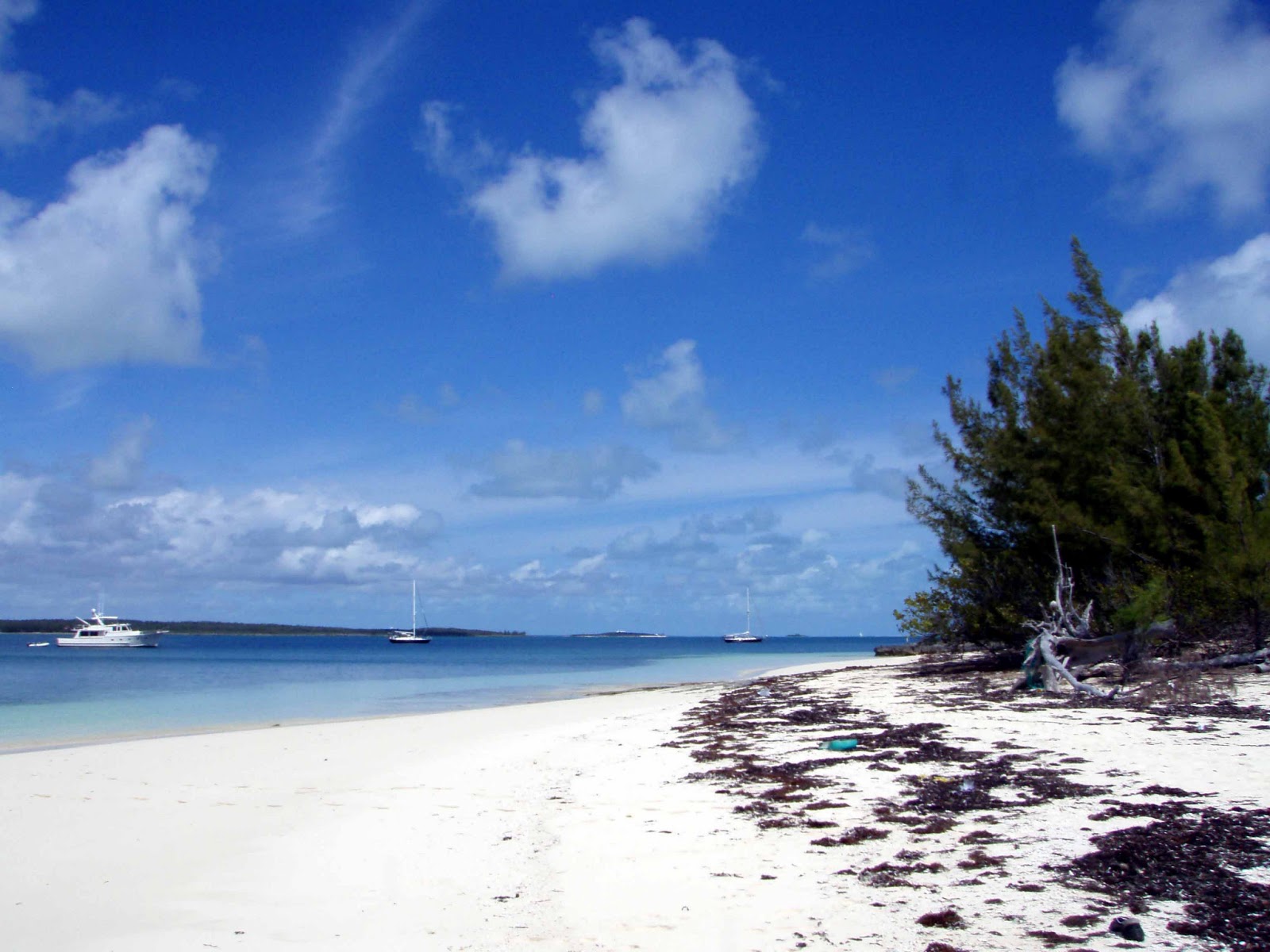
Lynyard Cay beach in the Abacos

We have arrived in the relatively tranquil and civilized Abacos. We spend a few nights anchored at Lynyard, decompressing, enjoying a lunch at Pete’s Pub, the only dining establishment in Little Harbor, and enjoying the relative solitude before heading off to Marsh Harbor, where after two weeks spent in isolated locations, we can dispose of garbage, do laundry, and replenish our produce supplies in a grocery that will rival anything found in the States. Marsh Harbor even has two stop lights – I don’t know how I will tolerate so many people and so much infrastructure.