Sunday, April 17, 2016

So Many Shades of Blue – Part 1


Welcome to the Bahamas! 
Sunset set as we head down the Tongue of the Ocean towards George Town - our first night in the Bahamas

After an easy and pleasant crossing, we are anchored off Chat and Chill (a popular beach bar and meeting place for all cruisers) in George Town, Exuma. 
Our anchorage off Chat and Chill, looking northward.

With three days of the annual regatta still left and 350 boats in the harbor, things are lively.  Burt manages to snag a last minute slot on a volleyball team, and they score a third place in the regatta tournament. We attend the closing party and, in a drawing, win a coupon for an hour’s massage at Nitza’s studio.  Nitza is the daughter of Lee who runs the laundromat – it’s a small world in George Town.  After regatta, things begin to slow down.  We still play Sunday evening trivia at the St. Frances Resort, attend water aerobics in the mornings if it is warm enough, 
Water aerobics off Monument Beach, another Stocking Island anchorage.
And the view of Monument Beach from the highest point on Stocking Island

Looking down from the Monument, an old navigation mark for Stocking Island.
and take time for chores like laundry, haircuts, and grocery shopping. Afternoons are spent at Chat and Chill for volleyball, basketmaking, and socializing with other cruisers.  We also take time to enjoy the natural beauty of Stocking Island, the barrier island that keeps Elizabeth Harbor so protected from all directions. Paths lead from the anchorages over the low hills and dunes to the Oceanside beaches.  
The view of a wind swept beach ocean side of Stocking Island.

On this miles long beach it is rare to see another person.  Although Eleuthera is known for its pink sand beaches, almost all the east facing beaches in the Bahamas sport pink sand – Stocking Island is no exception.  
We dinghy to Flip Flop beach on the harbor side and the location of a cruiser built gathering side and hiking trail over to the ocean.

On windy days, which we have most of the time, the surf pounds on the shore, but on milder days wading along the water’s edge is totally delightful. 
Wild waves - no swimming today!


Other days, rocky outcroppings make for protected pools.


We have volunteered to assist with a Long Island Rally which traditionally follows the George Town Cruisers’ Regatta.  Generally, the rally starts with a race between George Town and Salt Pond, Long Island.  We are busy signing up participants and calculating racing handicaps.  Meanwhile, we wait for appropriate weather as we don’t want novice racers to have to “race the house” to windward in rough conditions.  Finally a window opens, but after all the organizational work, there is absolutely no wind.  Our fleet of 31 boats ends up motoring to Long Island in glassy seas.   
R Kallista gliding over smooth seas on the way to Long Island. The water absolutely glows.

Even after our arrival, there is no wind forecast to enable us to hold a round-the-buoy race in the harbor.  Our racing rally becomes a sightseeing and partying rally. 

The Long Island Rally appeals to boats which are new to cruising, so we forego some of the planned events which we have done many times before, and head out on our own.  First priority is to deliver our hurricane relief supplies to the local contact.  The southern half of Long Island has been decimated by Hurricane Joaquin and residents have asked cruisers to bring school supplies. The government is rebuilding the schools effected and replacing all the text books, but paper, writing implements, art supplies, and other miscellaneous items need replacing. I bought out all such things at the Dollar Store in Vero and have them stored in a large plastic bin.  In addition, an organization in Key West donated environmental education supplies which were also on the wish list.  We are happy to have this freight off the boat and in the hands of those who need it.

We decide to rent a car for a day and venture to the north part of the island.  Hurricane damage this direction is much less noticeable although there is dying vegetation due to salt water intrusion in the low areas.  We head up to the north tip of the island and to Columbus Monument.  The road there is unmarked, and the term road is a bit misleading.  It is more like a track and our little Japanese import is having a difficult time of it.  I’m grabbing at handholds while Burt steers the car over rocks and through deeply rutted tracks.  This is Jeep territory and a Jeep we are not!  Miraculously we make it to the “parking lot” where we are the only vehicle in sight.  The monument is atop a high cliff and memorializes the native population and the arrival of Columbus.  
The plaque on the Columbus Monument

The residents of Long Island claim that this was Columbus’s first landfall in the new world.  Residents of San Salvador feel otherwise, and historians are beginning to side with them although they also assume Columbus did make a landfall in the small harbor nearby. Despite historical quibbling, the view can be universally appreciated. Multiple shades of blue extend out from the cliffs and into the estuary.  
The view looking east and into the estuary where is it said Columbus landed.
Sand bores and tidal creeks in the estuary.
 
The white cliffs below the monument.
The water is so clear that we can see a solitary sea turtle swimming amongst the reefs. This has to be one of the most spectacular vistas in the Bahamas.

A challenging drive deserves a nice respite to follow.  After renegotiating the drive back from Columbus Monument, we stop at Stella Maris resort for lunch at their oceanside open air restaurant.
Part of the deck restaurant at Stella Maris - rum drinks five steps away!

We sit on a deck overhanging the rocky shoreline and listen to the sounds of the pounding waves while enjoying a five-star lunch. Afterwards we walk on a suspended boardwalk along the cliffs to a pool that has been dug into the rocks and is filled by the surge of the ocean waves. 
The salt water pool - for an idea of the size, I am standing on the steps in the upper right corner.

After all that exertion, it is back to the restaurant for a rum drink in chaises overlooking a pink sand pocket beach before heading back to our rental car and boat.


That evening we participate in a cave dinner, held at Stella Maris, with the rest of the rally folks.  We pile into two school buses for the forty five minute ride back to Stella Maris.  The cave is on the resort property and now, at dusk, the pathway and cave interior are lit by beer bottles filled with kerosene and topped with fabric wicks ablaze.  The effect is mesmerizing and reminiscent of life in the Bahamas prior to electricity.  
Dinner in a cave - bats not invited.

We have a pleasant meal at tables and benches fabricated from the local rock while Bahamian musicians provide background music. 

The next day we schedule a beach clean-up for the rally participants.  During the hurricane, the container ship, El Faro, bound for Puerto Rico, was lost with all hands aboard off the eastern shore of Long Island. Besides the immediate tragedy, the island is struggling to recover from the massive amounts of trash that was deposited on the oceanside beaches. After a bumpy ride along a dirt track in the back of a pick up truck, we work about a quarter mile of beach where you couldn’t step anywhere without stepping on debris.  Besides the normal water bottles and caps, fishing nets, flip flops, deflated helium balloons, and miniscule flecks of colored plastic, we found the remnants of containers full of Mickey and Minnie Mouse dolls, Frontline Flea and Tick treatment, syringes, plastic soldier figures, and, best of all, Victoria Secrets bras – all items destined for Puerto Rico.  Although backbreaking work, we manage to fill fifty contractor bags and form piles of larger items before we give up for shade and water.   Our reward is an awards dinner that evening in a bar/restaurant at Salt Pond settlement. As there was no racing, we transform the sailing event into a fishing derby and award regatta flags and rum to the most successful.

The next day, most rally participants head off in different directions.  We choose to sail up to Calabash Bay at the northern end of the island, and home to the other five-star resort on the island, Santa Maria Resort.  The bay is a three mile crescent of pure white sand and is considered one of the ten most beautiful beaches in the world (or so says the Bahamian tourist bureau).  It is not far off that mark, and we find it impossible not to dive into the crystal clear waters and wander along the soft sand beach. 
Beautiful Calabash Bay - the resort is comprised by the buildings in the far distance.

The first evening there we join with two other boats and go into the resort for happy hour on the outside patio to watch the sunset.  After another day of relaxation, we again go to the resort for dinner with our friends on R Kallista, a couple from Port Stanley, Ontario who we met prior to leaving Lake Erie.  It is Burt’s birthday, and we celebrate in fine style. 
Our big night out - growing old does have it advantages

Our return to the boat is a bit more adventurous as the tide has gone out, and we find ourselves dragging dinghies long distances back to navigable water in our good clothes. The dinghy ride back to the boat is memorable under a full moon with the sandy bottom aglow.

The next day we have a wonderful sail back to George Town where we will wait out another week of strong frontal systems before we can venture northwards in the Exumas.

Tuesday, March 8, 2016

A Marathon in Marathon


Who would have ever thought we would spend three months in Marathon?  In almost five years of cruising, this is the longest we have stayed anywhere. El Nino is wreaking havoc in southern waters.  In Marathon we have strong fronts go through almost every other day.  We have record rainfalls for the dry season with December dumping 11 inches, January 9 inches, and February 6 inches.  Sunny days are hard to come by, and it is definitely cooler than normal. The harbor is packed full of boats; 225 are on moorings, about 150 are at marinas, and probably another 150 are anchored or med moored to mangroves.  It is unlike anything ever seen before as no one wants to leave this protected harbor.  In the Bahamas things are worse.  Three boats were lost (but fortunately no lives) attempting Gulf Stream crossings in February. Storms packing hurricane strength winds have roared through the islands, and friends tell of boats washed ashore, anchors lost, sails shredded, and significant damage done during dragging events.  The terror is still in their eyes.  On the other hand, we are happily bobbing at our mooring and making the best of the situation while watching our plans for the Bahamas shrivel.  

And between wind events, life in Marathon is good. 
Sunset from our cockpit in Marathon

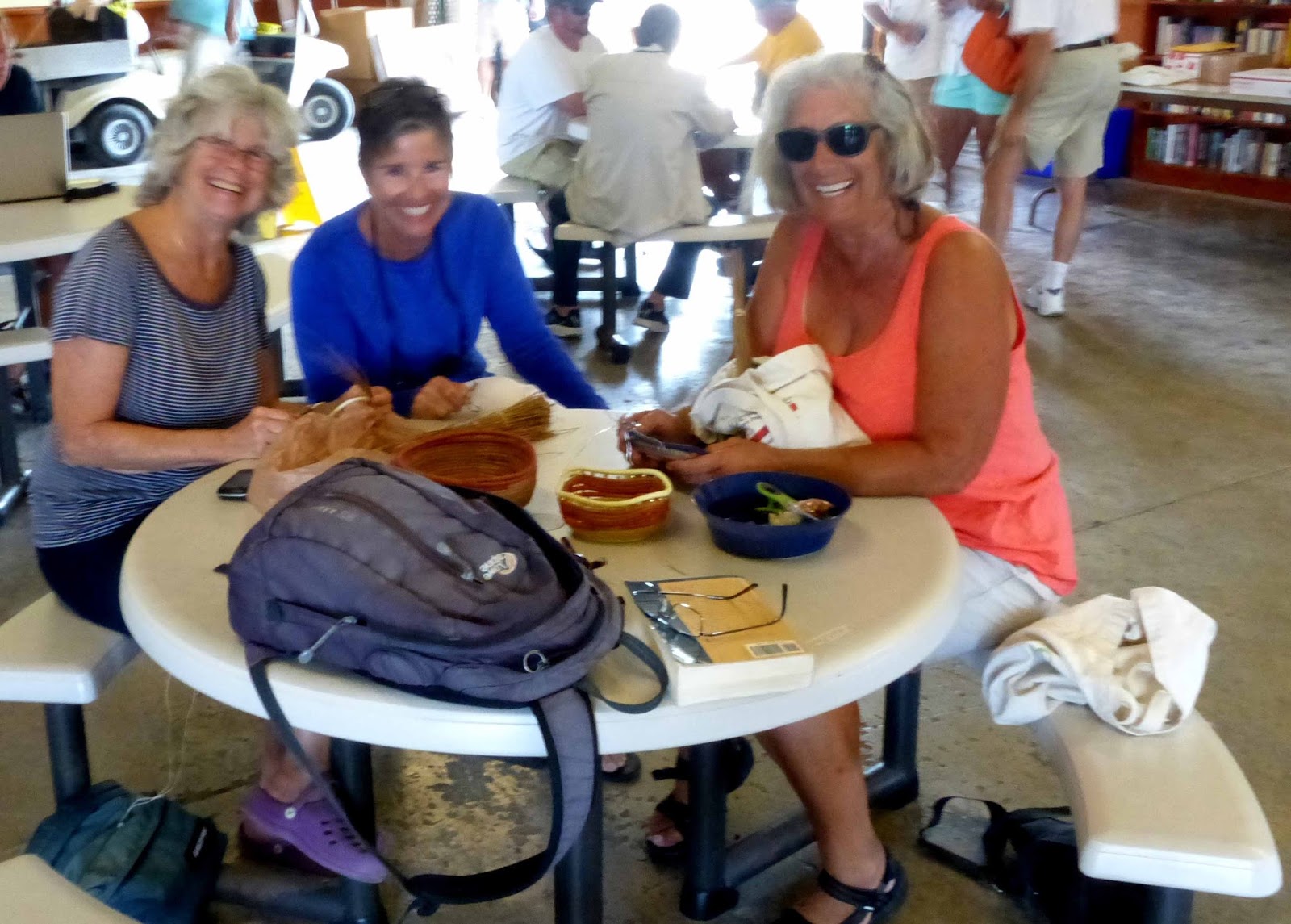
We have become gray haired groupies of two musical groups we really enjoy, following them to various venues in Marathon.  The basket making group is in full swing, and I enjoy my Thursday afternoons with the girls.  
Basket making in the marina commons area - about 25 women from all over Marathon show up each week.

Fridays mark the weekly SSCA lunch at a local restaurant. We make frequent forays to the local beach by dinghy and to the Seven Mile Bridge bike trail by wheels. We stop for lunch one day at Harbor Hillbillies, a houseboat anchored nearby that has been remodeled into a floating carryout restaurant. The young couple that runs it provides breakfast and lunch to dinghies that pull up to its float.  The food is great and cheap, but we wonder if the business will survive as, due to the weather, there are few days one wants to dine in a dinghy. Yet, we keep our ears to the weather watching for possible weather windows to the Bahamas.  Every so often one will tease us, but as the day arrives we realize it isn’t appropriate for heading out into the Gulf Stream. It is on these occasions we take advantage of the settled weather to venture out of the harbor.  

With four days of decent weather predicted, we head to Key West and the mooring field on the north side of the island.  Usually, it is mostly empty due to its northerly exposure, but this year we find ourselves at one of the furthest out moorings.  With the overflow conditions in the Keys this year, a mooring anywhere, comes at a premium. With our bikes, Key West is a blast.  We tootle down streets in the historic neighborhoods, take the bike trail that circumnavigates the island, and easily access some of our favorite destinations. We love the beach at Fort Zachery Taylor where we can rent chaises under the pine trees and watch the traffic coming and going into the harbor channel. 
A beautiful day at Ft. Zachery Taylor State Park - Key West

Key West means dining out, and we enjoy a gourmet dinner on the patio at Blue Heaven accompanied by a cat rubbing against our legs, breakfast on a patio surrounded by flowering bougainvillea at Pepe’s, and lunch overlooking Key West Bight at Schooner Wharf.
The view over Key West Bight from the deck at Schooner Wharf.

I make contact with Reef Relief, an environmental advocacy organization, and they generously donate classroom materials for 250 students in the Long Island (Bahamas) schools.  But the weather is beginning to turn, and we grit our teeth as we head out to motor into strong east winds and waves for fifty miles. 

Another opportunity allows us to head fifteen miles west to Bahia Honda State Park, a place we have visited by car or boat for over 25 years.  The main anchorage is tucked between the old and the new Overseas highway bridges.  
Standing on the old bridge with a view into the anchorage.  Exuberant is in the background.

Looking eastward at Bahia Honda Key
This is a place where you really want to dig in the anchor as those bridges seem pretty darn close. 
The old bridge with a cut out section that allows sailboats to enter the anchorage.

We spend two days walking through the park, sitting on the beaches, and socializing with several other boats which have ventured here from Marathon.  Threatening weather has us scurrying back to Marathon.

One sunny day we join with friends Ted and Sally to take the water ferry out to Pigeon Key for a tour. 
The old Seven Mile Bridge bisects Pigeon Key.  It will be refurbished in the coming years to halt deterioration and preserve this landmark for future generations.

We often bike out the Seven Mile Bridge to Pigeon Key and have been curious about what is ashore, but the only access to the Key is by the ferry.  We have an informative tour, learning much about the building of the Overseas Railroad and the life of Henry Flagler, the force behind the development of Florida’s east coast and keys.  It is a story of amazing engineering feats, devastating hurricanes, and a determined and foresighted man. Pigeon Key, now a National Historical Site, was one of the work camps for the construction of the railroad and many of the original building still exist. 
This supervisor's cottage is about 100 years old.

On the day we visit, a group of artists has come along for a painting excursion. 

The Keys support some interesting wildlife, besides all the unique residents and tourists.  Iguanas are everywhere.  
Really, Iguanas are pretty cool creatures.

As herbivores, they are no threat, but they have become such a nuisance there are exterminating services available.  On any sunny day, all you have to do is look up into the mangrove branches to see them hanging out.  Dolphins cruise the harbor daily and seem to be attracted to a patch of seagrass near our mooring.  A mother and baby are frequent visitors, and even after dark we can hear their breathing.  The pelicans keep us entertained with their funny “down the nose” gaze.
These guys are hanging out at a fish cleaning station at Bahia Honda

They frequently hang out near fish cleaning stations and can get a little temperamental if someone doesn’t throw them a tidbit. Our harbor has several groups of manatees in residence, but they are so low key you rarely notice them.  Unfortunately, motor props do find them as evidenced by the scars on the back of this one we saw at Bahia Honda. 
Besides are obvious scars on its back, this manatee also had a huge chunk missing from its tail.

And this year we have seen a more than normal amounts of Man of Wars at the beach.  They are pretty and interesting to see, but the tentacles can pack a nasty sting.
We saw hundreds of these in the Gulf Stream days later.  At first, with the sun shining on the sails, they looked like crab pots, albeit in 1000 feet of water. 
  

At this point we have just about given up on getting over to the Bahamas. We are holding packages to take to friends who had left for the Bahamas in December and decide to hand them off to another boat which is heading back to their home port.  I have a huge bin full of hurricane relief supplies we are donating to the schools in Long Island that were ravaged by Hurricane Joaquin this past fall, and I begin to investigate alternative means of shipping them there.  

Suddenly our weather router begins to talk about a period of calm winds.  We’ve seen this before and it never pans out, but this time the forecast continues to hold and with one day to go, we begin to make final preparations for a passage to the Bahamas. One does have to be ready to go on short notice.  Tuesday mid-afternoon, we drop our mooring for the last time, head to the fuel dock to top off the tanks, and exit the harbor heading straight south to pick up the Gulf Stream as it flows eastward south of the Keys’ barrier reef.  The depths drop like a rock, the water temperature rises, and our boat speed picks up over 3 knots at times  – we have found the Stream and ride it all the way to the Bahama Banks where we cross on to shallow, flat waters so clear that one can see the bottom by moonlight. It is a beautiful day on the Banks, and we marvel at the clarity and color of the water – Welcome to the Bahamas!  That evening we turn southeast into the Tongue of the Ocean with a mild breeze on our beam. The water is so flat that Burt grills hamburgers on the aft deck while we are underway.  The waters are not all that tame, though, as sunset is also dinner time for those beneath the surface.  We see scads of airborne flying fish, several large Wahoos leaping in the air, and shortly thereafter a sizable fin passing close to our hull.  We wonder if the shark smelled the burgers and wanted to join in. In the middle of the night, we cross on to the Exuma Banks, following the chain of islands south east before running out of depth where we exit into Exuma Sound, arriving in Georgetown around 5 pm.  As we enter the harbor, friends call on the radio to welcome us and invite us to a party on the beach, but we will be quarantined until we can check into customs and immigration the next morning. We covered 350 miles in 50 hours at an average speed of 7 knots.  Yes, the motor was running the entire time to ensure our arrival before dark, but we did motorsail extensively.  Considering the year, it is a perfect crossing, and now we are within 35 miles of our most southeasterly destination.  With spring on the horizon, we hope to have an easier trip northwards.