Friday, July 1, 2016

Singing the Blues (Angels and Malfunctions) in Annapolis


We arrive in Annapolis to gloomy, cool weather.  The mooring field off the Naval Academy is virtually empty.  With no paying customers, Bull and Bear, two traditional racing sloops that are normally tied up to docks, are out on moorings next to us. 
Bear on one of the nicer days of the week.


This is a busy time for us as we begin the process of shopping for the summer months and making a year’s worth of visits to our doctors and dentist in Annapolis.  Amazingly, almost everything is accomplished in one week.  We decide to replace our aging and very leaky dinghy as the dealer for our chosen brand is right across the harbor. Our new “ride” is a shiny inflatable with aluminum floor, and it is a definite improvement. 

Meanwhile, the weather begins to improve, and just in time as it is now Commissioning Week at the Naval Academy.  The high point of this week is two shows by the Blue Angels that occur right over our heads.  We move a bit to have the best mooring ball in the field for the shows.  Annapolis literally shuts down for this; stores and offices close, schools get out early.  And, the harbor becomes jammed packed with anchored boats – it is close to bedlam out there while we and guests that come out to the boat for both days enjoy relative peace at our mooring. 

Some of the crowds awaiting the Blue Angels
That is until the jets come roaring into Annapolis, then the noise is deafening. 
The dramatic arrival

For several hours during the Tuesday practice session and for one hour during the formal show we are amazed and entertained by these skilled pilots. 

At one point I am certain one of the jets goes between two of the light posts surrounding the athletic field right across from us – Burt disputes this but no matter, it was darn close. 

Two days later, we leave our mooring and travel about 15 miles south to Galesville and a marina we have been using for the past couple of years.  
The tranquil scene from our dock in the West River at Galesville.

We get a rental car, do some maintenance and cleaning that requires a dock with water and power, and prepare Exuberant to be hauled.  For the past year we have been experiencing increasing vibrations from our prop and now are faced with a choice to either have the prop removed and refurbished or purchase a new prop.  Neither is an inexpensive option, but we decide to go with a new and different style prop which will increase our motoring speed and fuel economy.

While the boat is out of the water awaiting its new prop, we head west in the rental car, stopping first in Chagrin Falls to spend a night with Burt’s sister and husband, and then proceeding to Wisconsin to visit our older son and his family.  With two boys ages nine and six, it is a lively time. The soccer season is coming to a close, and we are the cheering section at both boys’ games. 
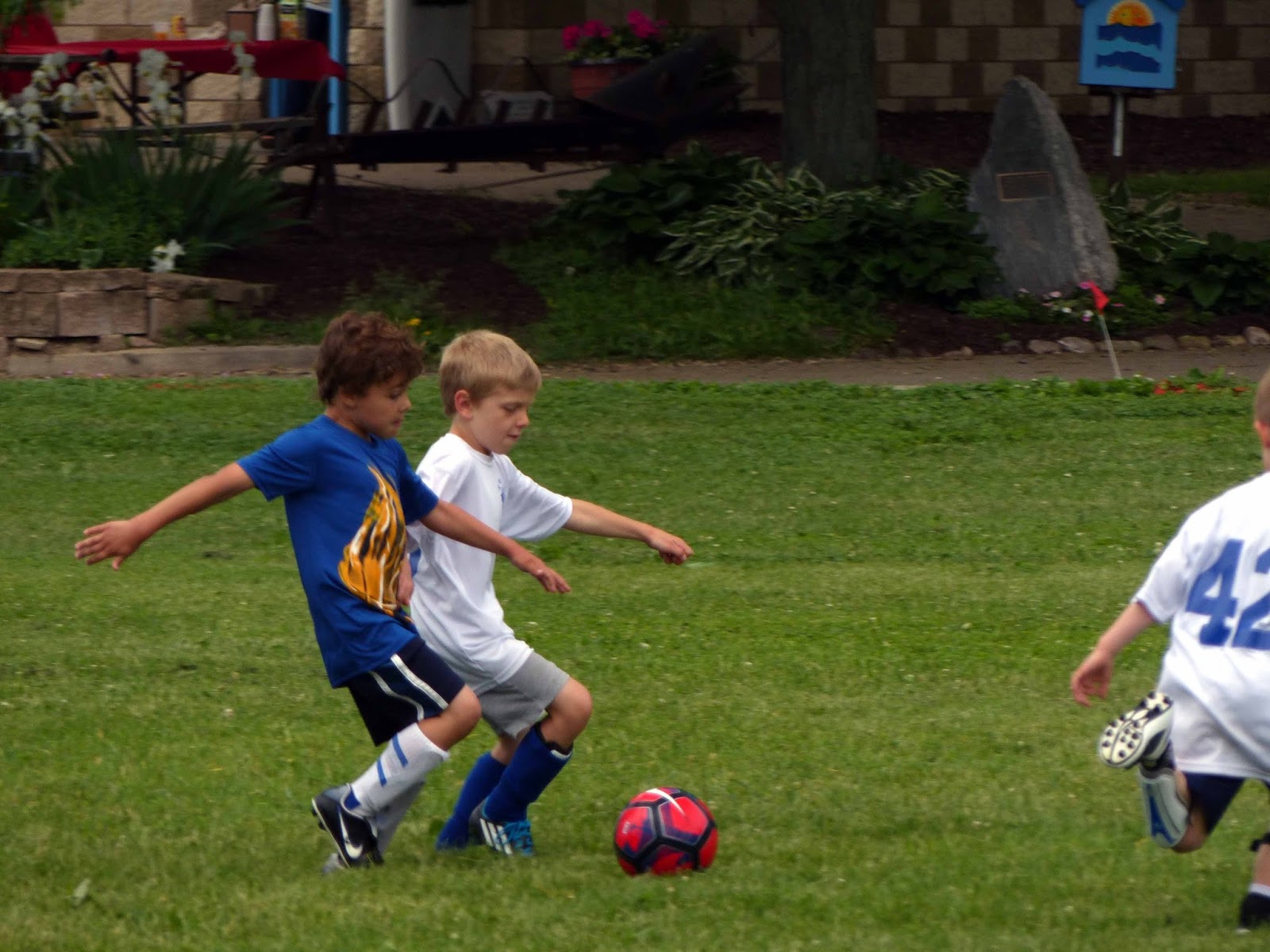
Daniel is a pretty aggressive player, probably because he trains against his older brother

William's team (coached by his Dad) wins their final game of the season against the then undefeated league champions.
But the soccer doesn’t wear them out – our stay also includes playing football and baseball, flying kites and drones, taking extended bike rides, and going to the neighborhood pool.  My only salvation is breaks with Daniel to work on one of his passions – 1000 piece jig saw puzzles. We are exhausted and only wish we could get an energy transfusion. On the way east we stop in Mansfield for a night to visit with Burt’s brother and his wife.

Upon returning to Galesville we find our boat has been launched one day early, so we are not able to inspect the installation of the new prop.  We take the boat out for a brief sea trial and find the prop seems to work perfectly but the engine overheats due to a disintegrating impeller. So we drop anchor and replace that on the fly. It looks like we are good to go, so after a day of last minute provisioning, we cast off our dock lines to make our way towards Connecticut where Burt and I are scheduled to give a presentation at a Gam.  About an hour out, the high water bilge alarm goes off – a first for us as we momentarily wonder what that funny noise is before springing into action.  One glance into the engine compartment proves we are taking on water at an alarming rate. The two automatic bilge pumps cannot keep up with the flow so I begin pumping with the emergency hand pump while Burt assesses the situation.  A hose that attaches the shaft through-hull to the stuffing box has become unattached. With the engine shut down the leaking greatly diminishes and Burt reattaches the hose with the clamps. Once the engine is restarted, the hose just slides off and water again pours in.  With the engine off, Burt is able to wedge the hose on with a block of wood. We alert the marina and mechanic that we have a problem and make our way back to the marina under sail.  Needless to say, adrenaline is flowing.  The initial thought is to pull the boat immediately, but there is a northwest building breeze, the water levels are dropping rapidly, and we are too deep to make it into the well by the hoist. We tie up at a dock on a Friday and it isn’t until Tuesday morning that the winds subside enough to allow us to be towed to the hoist.  As soon as the boat is on the hard, the mechanic appears to discuss what needs to be done.  First, we notice that the prop shaft is 1 ½ inches too long.  It is removed and taken to a machine shop to be shortened.  But that wasn’t the issue with the leakage. It is a long story, but the bottom line is we will need a different sized stuffing box to make a more secure hose attachment.  By the next morning, the new stuffing box is installed on the shortened shaft, and we are underway for another sea trial that proves to be successful.  A few days later, with the appropriate weather window, we leave for New England, but with the delay, we will not make it to Connecticut in time to give our presentation, leaving us frustrated that we are not able to meet our obligation. 

We leave Annapolis at sunrise and motorsail to the north end of the Chesapeake.  
Sunrise while approaching the Bay Bridge.

There we anchor for a few hours awaiting the positive current in the C&D Canal. Upon entering Delaware Bay we have a tidal current against us and against the wind, resulting in several hours of unpleasant motoring into steep waves.  Cooking dinner is a challenge, but once the current switches, it is an easy trip down the Bay and into the Atlantic.  With our new prop, our boat speed is better, and we find ourselves approaching New York Harbor in the late afternoon with the optimal currents.  Rather than drop the anchor at Sandy Hook for the night as planned, we continue on through New York City, seeing speeds of over 12 knots at times. 
It is a beautiful late afternoon when we arrive in New York City

We eat our dinner cruising along the East River 
Each bridge along the East River is different but they all have interesting architectural details.

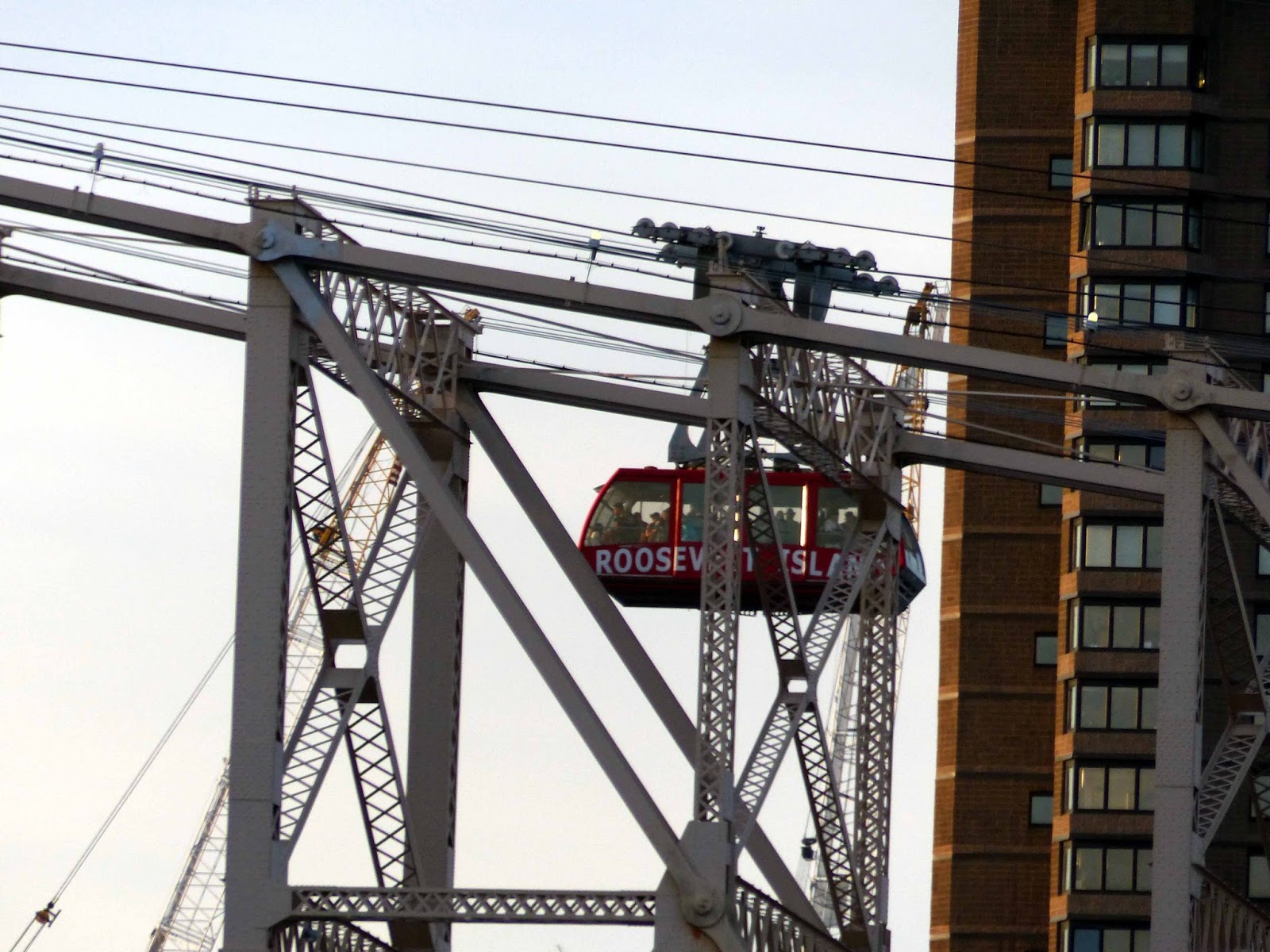
My favorite way to cross the East River - via the cable car that connects Roosevelt Island to Manhattan.
and drop the hook just after sunset at Port Washington on the western end of Long Island Sound.

A passage like that deserves a day of rest, and besides, Port Washington is the only place we know where the huge Stop and Shop Grocery Store has their own dinghy dock. We celebrate our arrival with a happy hour on Exuberant including two other couples we know through, among other things, the daily Cruiseheimers radio net. 

The next morning we set off on a 50 mile jaunt to the Thimble Islands, located just east of New Haven on the north shore of Long Island Sound.  Cruising friends have a mooring there that we can use, and it gives us a chance to catch up with them over dinner as we haven’t seen them since Marathon.  The real joy of the Thimbles is taking a dinghy ride through this archipelago of small granite islands.  Almost all sport one or more attractive homes of various architectural styles. 
 
Not a bad place to curl up on a summer's afternoon.
Some of the homes are palatial.

Others cling to their rocks.
It is certainly a magical place.

One more day further east brings us to Stonington, Connecticut, a delightful town of restored sea captain homes.  We wander the main street, 
The view from one home overlooking the harbor.

Color and details add interest.
duck into a lighthouse/museum, and take a brisk walk to the outskirts of town to visit the restored home of Captain Nathaniel Palmer. 
Captain Palmer's home, now a museum.

Captain Palmer’s claim to fame is, while on a seal hunting expedition, being the first person to set foot on Antarctica.  The base at Palmerston Island honors this discovery.

Despite its charm, our main reason for visiting Stonington is to rendezvous with our other son and his family for dinner. One of the hardest parts of cruising is the lack of opportunity to frequently visit our family, and with growing grandchildren that becomes even more painful.  We have not seen our granddaughter since last September, and she has grown and changed so much over the months. We are delighted that we will have more opportunities to visit with her (and her parents) this summer.  
Yup, she's a Preston - loves the beach and water and thinks Grandpa's big boat is pretty cool.


Saturday, May 21, 2016

The Spring Migration North


The two best sounds on a boat are when the engine goes on (it starts when the key turns) and the engine goes off (you can sail instead of motor).  We have been experiencing a few problems with the former during the past couple of weeks.  Burt worries the starter battery is dying, but sometimes it does work.  Burt worries that electrical connections are corroding so he cleans and polishes many connections in the complicated system.  We still have issues, but fortunately our electrical system has redundancy and he is able to reconfigure it in different ways until we can limp home to the States.  During one “reconfiguration” we manage to blow up the solar panel regulator, so we no longer can charge with solar power.  But, not to worry as we still have a generator/battery charger, two alternators, and wind power. A new regulator will be awaiting us in St. Augustine.  Then one alternator stops working.  It is getting a bit tenser on board.  We are able to start the engine to make it through the channel into St. Augustine and pull up to the fuel dock to refuel.  When we try to start the engine to leave for our mooring, it won’t start, no way, no how.  We are taking up valuable room at the fuel dock, boats are queuing up to fuel, and we are frantically trying to diagnose the situation.  With kibitzing from the marina personnel and a phone call to a local diesel repair guy, we determine our starter has died.  We carry a spare on board, so Burt changes it out feeling very much under pressure as the dock hands walk by frequently asking how things are going.  Miracles do happen, and several hours later we pull off the dock and head to our mooring.  I don’t think we will be missed at the fuel dock. For weeks we have dealt with this issue, losing our way in the complexity of the boat’s electrical system and not checking out simpler solutions – such is the way with boats.  During our six day stay, Burt replaces the solar regulator, re-draws a schematic of the electrical system, and pulls out yards of old and unnecessary wiring.  We are whole again.

The remainder of our stay in St. Augustine is most enjoyable.  We indulge in full-fledged grocery stores, marine stores, and hardware stores, all accessible with a cruiser’s shuttle service. We have many meals out with fellow cruisers as St. Augustine has a myriad of interesting restaurants to explore.  
Dinner out with cruising friends Debby and Fred from Early Out and Fran and Harry from Sirius - St. Augustine is always a very social place.

And we play tourist, biking around St. Augustine and visiting a few attractions.  First stop is Memorial Presbyterian Church, a beautiful church built in 364 days to memorialize one of Henry Flagler’s daughters who had died.  It is a fine example of the Spanish influenced architecture that infiltrates so much of St. Augustine. 
Beside the main structure is a charming prayer garden.
The exterior detail work in brick and stucco, the elaborate hand carved wood interior, and stained glass windows depicting the Apostles Creed are testament to Flagler’s grief.
Carved stone, decorative brick work, and tiles demonstrate the Spanish influence

The interior with an elaborately carved wooden screen hiding the organ and extensive rows of pipes.

Another day we visit El Galeon, a Spanish built replica of a 16th century Spanish Galleon that would have plied these waters.   
El Galeon at the dock in St. Augustine.

St. Augustine is considered its North American home port so it is often here.  The crew is comprised a young Spanish students who take a semester or year off from school to sail a tall ship.  Their English is passible, but they have difficulty explaining some of the technical aspects that so intrigue Burt.  We wander through the ship and notice that much of the interior is actually re-enforced with fiberglass that is crudely disguised behind wood paneling.  The rigging seems far more authentic and complicated.   
A complicated array of halyards.

This ship will be participating in the international tall ship events this summer on the Great Lakes.

We find a weather window to depart St. Augustine and make a 48 hour passage in the ocean to Southport, North Carolina. There isn’t much wind to begin with so we motor sail in benign seas. Long passages at sea are not always as boring as one might think.  During this trip we are often accompanied by playful dolphins.  
Dolphins playing in our bow wake many miles offshore.

 Even fifty miles offshore, we see several large sea turtles swimming westward; probably we are witnessing the beginning of the nesting season.  
A poor picture of a sea turtle - they are always hard to photograph.  This one has many barnacles on its back.

And this trip we also have a hitchhiker on board.  A little bird makes Exuberant a resting spot on its migration north.   
After a bit of a respite, it was off to who knows where.

Sunrise at sea.
Just north of Charleston, we begin to sense a change in the weather. What should have been mild northwest winds and seas goes directly on our nose and thunderstorms begin to form around us.  It gets uncomfortable and a bit tense as we dodge squalls, so we are delighted to head into the Cape Fear River at daybreak although we continue to worry about our buddy boat which is heading further up the coast to Beaufort, NC.  Later we hear they have arrived safely and are also complaining about the unpleasant conditions.

We have never been in Southport before although friends all tout its virtues – a small fishing village that has become gentrified.  We enjoy biking through the town and along the waterfront, typical of Carolina low country with marsh habitat and wandering waterways behind barrier islands.  
The view across to the barrier island.

 We treat ourselves to dinners out at the cute fish houses along the waterfront.  But most important, we make ample use of our dock as the last time we were at a dock with water and electricity was back in early October.  The boat is filthy.  The cockpit grate is raised to reveal the history of many happy hours, all molding away.  The cockpit cushions have mildew forming in the seams. The deck is stained by bird droppings and rusting stainless.  The hull is glazed with salt accumulations.  We put in two days of hard labor which only makes a dent in the mess.

We are trying to slow down our trip northward as the weather in the Chesapeake is unseasonably cold.  Our next stop is Wrightsville Beach, a mere twenty miles further up the ICW, and another new destination for us. It is a beach resort town with a nice protected anchorage on the backside.  We take bikes ashore for a trip to the grocery and West Marine store.  Later we ride through the town and along the shoreline.  The beach extends as far as the eye can see, stopping only at the Masonboro Inlet to the south where we will depart the next day.  We find a lovely restaurant on a pier at the south end of the beach and enjoy linner (a combination of lunch and dinner) watching the few brave swimmers and surfers in the cool, pre-season waters.
Looking south towards Masonboro Inlet


At first light, we exit Masonboro and head northeast toward Beaufort, NC. The wind is light as we initially motorsail with rolling waves hitting us on the beam, again, not a particularly comfortable point of sail.  As the wind builds we find our prop is making unpleasant noises and vibrations, requiring us to either sail very slowly downwind, or constantly adjust RPM’s to minimize the vibrations – another issue that will need to be addressed once we reach Annapolis.  When we finally pull into Beaufort at dusk, we exhaustedly drop anchor near the entrance and give thanks we are done with ocean passages for the foreseeable future. It is a quick trip the next morning up to Oriental, Exuberant’s original home port and a favorite stop for us. 

More bad weather is approaching so we sail another forty miles to Ocracoke Island on the Outer Banks and the National Park there that has very inexpensive docks adjacent to the charming town.  We don’t know how long we will stay as with the storms comes another round of unseasonably cold weather.  We have electricity so we will have heat, but up in the Chesapeake it is ten degrees colder.  As it works out, we spend nine days at the dock.  When conditions permit, we continue our semi-annual clean up.  Burt polishes the stainless and finishes cleaning the hull and deck.  He waxes the fiberglass on the deck and cabin top.  Meanwhile, I empty all the interior storage areas, cleaning and inventorying the contents in preparation for reprovisioning in Annapolis.  Walls, louvers, and ceilings are washed with vinegar to prevent mildew, a constant issue on boats. A few times we take a break, biking through the town, enjoying a few meals out at several surprisingly good restaurants, and one day we even venture out to the beach where storm produced waves pound the shoreline.  
Endless dunes and beach at Ocracoke Island, located on the south end of the Outer Banks.

It is still off season, and we have the beach to ourselves as few people have invaded this summer vacation spot. 

At this point we have a choice.  We can back-track to the ICW and travel the remainder of the way to Norfolk on the waterway or we can continue north through Pamlico Sound and avoid some tedious miles.  Typically the latter is considered a shoal draft route only, but friends have just make this trip and claim we can get through with our 7 foot draft if we proceed carefully and follow some very specific instructions.  Bravery wins out, and we head for Manteo on Roanoke Island.  After some open water sailing we enter a twelve mile long channel that will be very unforgiving if we wander off track.  An individual at our dock in Ocracoke claims we won’t make it, but nine miles into the channel he is aground and we are chugging happily along to our destination, the village of Manteo. The abrupt turn into the Manteo’s channel is the most challenging portion, and we execute the turn perfectly, entering the harbor with six spare inches under our keel.

Our efforts are well worth it.  Manteo is charming.  Once a fishing village, it is now more upscale but still shows its roots.   
A boat shed turned Nautical Museum sits on the shoreline near our dock.

Our dock in the heart of town gives us access to the village and a bike trail that heads four miles further north to a National Park site. Do the names Roanoke Island, Sir Walter Raleigh, and Virginia Dare ring a bell?  It was at this spot that the English built their first settlement in the New World and Virginia Dare was the first English child born in the Americas.  The settlement was short lived, and its disappearance shrouded in the mystery of the Lost Colony, but archaeological excavations and artifacts on display in the park museum document its existence. 
The earthworks at Ft. Raleigh after reconstruction by archeologists.
 
Historical marker explaining the history and significance of Roanoke Island

A replica of the boat that brought the settlers to Roanoke Island - it's much, much smaller than El Galeon

Nearby are the Elizabethan Gardens, a large tract of waterfront land maintained by the Garden Clubs of North Carolina, which illustrate typical garden design of the Elizabethan age, albeit with plantings suitable for the Carolinas.   
Beautiful wrought iron gate gives a glimpse into the gardens.

We enjoy strolling through the many pathways, admiring the garden design and sculptures, and learning about low country vegetation.  
One of the formal gardens with boxwood hedges, crepe myrtle trees, sculpture, and fountain.
I find the patterns in the entwined branches of the crepe myrtle to be intriguing.

 Dinner out in a village pub makes a delightful end to a delightful Mother’s Day on Roanoke Island.

The next morning we are challenged by another channel around the north end of the island.  Named Six Foot Channel, the shallowest we see is 8 feet, and that is only for a few miles. As luck would have it, just as we leave our dock, the chartplotter goes on the blink.  We really need its guidance to get through the next couple of hours.  With some quick thinking, we realize our tablet has some basic chartplotting capabilities, so we fire that up although it is difficult to use in the daylight of the cockpit. But, the real challenge is avoiding the many crab traps distributed through the area in no logical manner.  Unlike Maine lobster pots, these buoys are dark colors and often are floating low in the water.  And we have fog to make things even worse.  For several hours we proceed slowly, straining our eyes to avoid any entanglement. An audible sigh of relief can be heard when we reach open water.  We anchor in a remote area several miles north of the Albemarle Sound, leaving us about fifty miles left on the ICW to reach Norfolk.

Our final stop before leaving the ICW is the town of Great Bridge, actually a suburb of the Portsmouth/Norfolk area. Just south of Great Bridge we encounter five F-18 out of the nearby naval air station, running landing drills.  They swoop over our mast at low altitude as they approach the runway.  The noise is deafening; the sight, awesome.  
Wouldn't want to be onthe wrong side of these guys.

There are few boats stopping in Great Bridge so we ignore the sign saying 24 hour maximum tie-ups at the free dock wall and stay two nights, allowing time to run errands and grocery shop.  Besides, the further north we go, the colder it gets, and we’re trying to find excuses to slow down.  Finally we depart for Norfolk.  It is only eleven miles but it seems to take forever as we have to pass through a lock, bridge construction limits passage opportunities in other locations, and every rail bridge we encounter is closed for slow moving trains. It’s only eleven miles but it takes over a half a day – such is the way in this neck of the woods. It is an interesting eleven miles though, as we pass ship yards with dry docked naval boats, ocean freighters employing huge gantry cranes to unload their containers, and barge traffic from every direction.

As we approach Mile 0 of the ICW we find a dock available on the Portsmouth side of the river in a niche that is used as a ferry stop.  We tie up with only one other boat around. A two day respite gives us an opportunity to explore Norfolk.  For $.75 each way, we can board the ferry with our bikes to head across the Elizabeth River to Norfolk.  We wander along the waterfront bike path, past the Battleship Wisconsin docked by the Nautilus Museum, 
Looking at the bow of this massive battleship.

past the Chinese Pagoda donated by Taiwan to the citizens of Norfolk, 
Strange juxtaposition of the Wisconsin superstructure with the intricate designs of the pagoda.

and through the restored Freemason neighborhood, where nineteenth century homes and townhouses and have brought back to their initial splendor. We even stop at an upscale mall to pick up a few items.

But, it is time to bite the bullet and head into the Chesapeake despite the cold temperatures. We make a long hop up to Reedville on the western shore just south of the Potomac River for a first time visit.  The sheltered harbor will provide a secure anchorage for yet another serious front bearing down on us. Nestled between the quaint town and lovely homes with lawns that slope down to the water’s edge, we remain comfortable through a stormy, windy night. Reedville is famous for its fishing industry. You will never eat any of the fish caught and processed here in a recognizable form, but you will consume the bi-products. 150 foot long fishing boats use seine netting to capture menhaden that is processed into the fish meal and fish oil found in many commonplace product today.  In fact, the port of Reedville receives the second largest tonnage of fish in the United States following a port in Alaska.  Fish by-products is a lucrative market providing the residents of former and current times with prosperity unlike any other village along the shores of the Chesapeake.  The modern shore side factory, the huge fleet of large fishing boats, and the lovely homes, some dating back over a hundred years, testify to this.  
A lovely restored  Victorian home along Reedville's main street.

 We learn more about the fishing industry at a local museum on the shores of one of the town creeks.
The remains of a log canoe with two restored Chesapeake work boats in the distance at the Reedville Fishing Museum.


Another day battling north winds gets us to Solomons Island where we drop the hook and stay put on the boat – it is cool and dreary on shore.  The next day we arrive in Annapolis with fog and rain.  We have no trouble finding an empty mooring as all but two are unoccupied.  This cold spring has been caused by a stationary weather feature along the North Carolina/Virginia boarder that channels storms along Cape Hattaras and cold, rainy weather northwards.  In fact, it is actually warmer and sunnier in Maine than here in Annapolis. In the few days we have been here, we have had just 36 hours of decent weather. Fifty some degrees and rain on a boat without shoreside electricity can be pretty chilling. But, there is hope. In the coming week, we may finally see a return to more seasonable weather.  We just hope this time the prediction is correct.