Tuesday, October 30, 2012

Dancing with Sandy


We are working our way down the ICW, inside of Cape Hatteras, sometimes sailing and sometimes motoring across open sounds and through rivers and man-made canals.  It takes us a total of four days to make it to the ocean again at Beaufort/Morehead City. Our plan is to sail out to Cape Lookout, anchor for the night, and then depart down the coast on the outside for a 30 – some hour passage to Charleston, SC.  We visited Cape Lookout a year ago and are anticipating another night in a spectacular anchorage.  In addition, with our first access to truly clear, warm water in months, Burt wants to snorkel the boat to check the zincs.  But, nothing goes as planned.  The wind has picked up as we motor out the channel, sails are hoisted, and we are moving along at a nice clip.  It time to shut down the engine, but as I lean over to do so, I notice the engine panel is no longer functioning.  In all likelihood we won’t be able to shut off the engine and also won’t be able to restart it.  Burt makes a cursory investigation of the situation and can come up with no logical explanation. This is not a good scenario, so we call a marina in Morehead City to see if they can accommodate us, and if they could get an electrician to our boat. With a positive reply, we turn around, motor in to the marina, and find, yes, we can not shut off the engine.  Burt is tinkering with the panel while I go in to register.  When I get back, the engine is off, and Burt is smiling.  As usual, when things go wrong, it’s mostly likely the simplest solution that solves the problem.  In this case, one of us had accidentally tripped a switch that provides power to the panel. Cape Lookout was not meant to be, and as we later find out, that’s a good thing. Apparently, it is known to have large schools of bull sharks in the anchorage, and thus is not a great swimming hole.

We have an uneventful passage to Charleston in the company of several other boats and arrive at an anchorage we used last spring. Awaiting us are friends we made while at the boatyard in Deltaville last summer. We set the anchor solidly as this spot is known for less than perfect holding and strong tidal currents. In the next three days we see three different boats without people on board adrift.  One broke its mooring line, one managed to break free by wrapping its anchor trip-line around its rudder, and the final one just dragged its anchor.  In all three cases, the boats are rescued unharmed, but it is a bit unnerving. 

But, we are back in Charleston, one of our favorite cities. Besides tending to basic necessities and chores, we spend time biking through the quaint side streets.  Instead of smelling the jasmine of last spring, we hear the sounds of leaves crunching underfoot.  It is fall in Charleston, and the trees are just beginning to turn. 
Home along Charleston's waterfront
Garden behind a home in Charleston
Window boxes with orchids along Charleston street


One of our cruising friends mentions that there is a Lightning regatta in progress on the other side of town.  As we had competed in Lightnings many years ago, we dash over to the club to see the spinnaker finish of the last race.  Forty racing boats with their colorful spinnakers out in the harbor is a beautiful sight.  After the race, we enjoy greeting several skippers with whom we had sailed many years ago. Another day we ride our bikes to the top of the new suspension bridge that spans the Cooper River.   
Bridge over Cooper River in Charleston

In a moment of enlightenment, the designers included a wide pedestrian lane that accommodates both foot and bike traffic.  It is well utilized by an assortment of people, and we enjoy the view of the city and the opportunity to see the structure of this bridge up close. 
People bike and walk beside the impressive structure of the bridge
Who (excepting my brother-in-law) knew a bridge could be so beautiful?

Late in our stay we host a happy hour on our boat for three other boats, all past residents of Great Lakes states.  One boat is from a neighboring sailing club in Sandusky – it’s a nice opportunity to reconnect with the crew who we have known for years and who are helping deliver the boat to Florida.   
The guys from Sandusky appear to be behaving themselves

The next day all our guests are all taking off for an off-shore passage south.  All, that is, except our friends from Deltaville who can’t retrieve their anchor.  They call in a diver who discovers the anchor has dropped down a hole in some metal framework lurking on the bottom, and he is unable to extract it.  The only option is to cut the anchor chain and lose the anchor, a very expensive proposition.  We agree to help them the next morning. At the appointed hour we are ready to get into the dinghy when we notice the boat is gone.  A call on the VHF reveals that they had taken all the slack out of the chain, to save as much of the length as possible when they cut it, but it just kept coming and coming until suddenly they had the anchor back on the roller and were adrift. One is thankful for small miracles!  The next day we plan to leave and, in preparation, we pull up a secondary anchor we had set to control our motion in the current. But, it is an unusually difficult job and part way down the rode, we find a small outboard motor entangled in the rope.  Yes, this isn’t the greatest anchorage and the bottom is littered with junk, but it affords excellent access to a wonderful city.

Our next passage is an overnight in lumpy seas to Savannah. We have made arrangements to stay two nights at a marina near bus access into the city of Savannah. Over the past few days we have been hearing about the possible formation of a tropical low that could develop into a hurricane with its sights set on the US east coast, and now our weather service makes the predictions sound increasingly dire.  When we arrive at Thunderbolt Marina I plead for an extension to our reservation as now our nemesis has a name – Sandy. Docks are suddenly at a premium, and we are delighted to find out that we can stay put as long as necessary; we take the last dock available at this facility.  Rather than take a day off to tour Savannah, we spend our time preparing our boat for a potential hurricane.  Extra dock lines are retrieved from the bilge and spare fenders are inflated and put into position.

And we wait.  We bike around the town of Thunderbolt, visiting the nearby Bonaventure Cemetery, a huge Victorian styled cemetery with fascinating tombstone sculptures and crypts housing the remains of many historical significant Georgians.  The cemetery was featured in the movie Midnight in the Garden of Good and Evil. With moss draped live oaks swaying in the building breeze, it is a spooky place to visit just a few days before Halloween. 
At Bonaventure Cemetery, the Gates of Heaven overlooking the river - this is the plot of one of Savannah's leading families
Old headstones and hanging moss combine for a surreal experience


And we wait.  We wander through the extensive Thunderbolt Marina yard and basin.  This is one of the few facilities on the east coast that can service the largest megayachts.  A number of them that are over 200 feet long are at docks, on the hard,  or inside the huge painting facility. 
Our little sailboat seems dwarfed in comparison to these megayachts

Uniformed crews with foreign accents scamper about supervising the refits that are in progress.  Another cruiser informs us that one boat just had a $4.4 million dollar extension added to its stern to house a second hot tub.  It’s hard for us to comprehend such wealth.

And we wait.  We have a nice dinner at the local open air restaurant, holding on to our napkins to keep them from blowing away. We watch the local high school’s homecoming parade with a group of proud mothers.

And we wait, for what?  Sandy passes well off the coast of northern Georgia, and we see no more than 30 knots of wind, no waves along our protected stretch of the ICW that is five miles inland of the ocean, and no storm surge of notice. This is the only stretch of the Atlantic coast that does not have either hurricane or tropical storm warnings.  The seas outside in the ocean are huge, so we will stay here until things subside, but we are never in any danger.  It is a great first close encounter with a hurricane, but we do worry about our cruising friends in less protected places that are closer to the path of Sandy. Emails are flying amongst our community and the daily ham nets are abuzz – who is where and what they are doing to prepare, what are boats closer to the storm experiencing, and the frightening details of the mayday and rescue of a large fishing boat with over 30 people on board adrift without power in Bahamian waters during the height of the hurricane.  We hear the stunning news that the Bounty, the replica tall ship that was featured in the movie Mutiny on the Bounty, has sunk off the shore of Cape Hatteras, leaving two crew unaccounted for. It strikes home as we had seen her up close this summer in Newport. We suspect we will be hearing “Sandy” stories well into the winter cruising season.

The aftermath of Sandy is still with us.  We have sunny, but cool days and the winds off the trailing cold fronts are at times brisker than what we experienced during Sandy. We will stay put for a few more days until the winds and waves subside. The weather gives us a good opportunity to visit the old city of Savannah. We take the local bus into town with our folding bikes in the convenient exterior racks.  Once we get into the city and obtain tourist maps, we take off on our bikes through the historic neighborhoods.  The city plait contains square neighborhoods with central parks and side streets in orderly fashion.  Savannah is unique in the south as it was never attacked during the Civil War.  Instead, Gen. Sherman stopped just short of Savannah in his March to the Sea, claiming the city was too attractive to level. The antebellum homes, parks enhanced with monuments and fountains, and the rows of moss draped live oaks are enchanting. 
A charming Savannah home now converted to an inn
The Forsyth Fountain in the historic district of Savannah

We weave through various neighborhoods to the river front where we find four story rehabilitated warehouses, now occupied by shops and restaurants, along a new brick river walk.   
Looking past a rehabbed warehouse to the river front

We stop along the waterfront docks to chat with a boat that did the Charleston to Savannah passage with us; finally we get to meet this Australian circumnavigator in person.  We end our day of tourism with dinner at a waterfront restaurant.  When this warehouse was remodeled into the current restaurant, they found a map of Sherman’s March to the Sea drawn on the wall by the officers that were billeted there. This portion of the wall is now under glass and climate controlled, and we marvel at the opportunity to see history at such close range.   

We hope to leave shortly for an ocean passage from Savannah to St. Augustine, a distance of 120 nm, but the weather situation will be the controlling factor.  Many boats have resumed their southern migration down the waterway, but the Georgia and north Florida sections of the ICW have many shoal areas, and, with our deep keel, we will have a much easier and safer trip if we stick to the ocean.  And, meanwhile, we think of those people up and down the coast who have been confronted with so much devastation.  When you travel the coast so intimately, Sandy and its repercussions seem much more vivid.

Friday, October 12, 2012

Coming Full Circle


It has been a little over a year since we left Ohio and started our new life as live-aboard cruisers. We arrived in the Chesapeake via truck, thanks to Hurricane Irene, and once we reassembled the boat, we left immediately for the Seven Seas Cruising Association Gam at Camp Letts, just south of Annapolis.  This year we return to the same location and same event as much more experienced cruisers; thus, we have come full circle.

We have volunteered to help with the Gam set up as the organization relies extensively on member assistance.  Volunteering has its benefits; during down times Burt has the opportunity to visit extensively, one on one, with Nigel Calder, the key note speaker, worldwide known author, and foremost authority on boat systems.  He gleans much information on making our electrical system function more efficiently. Once the Gam begins we greet many friends we have made over the last year and attend a number of seminars on subjects such as medical emergencies on board, interpreting charts and avoiding their inherent errors, alternative energy systems, suggestions for passages on the ICW, and interesting cruising destinations.  We join 400 other participants for meals and other social activities and leave with the conviction that we will be there again next year. 

We return to Annapolis and an actual dock with electricity and water offered to us by friends we met in the Bahamas.  Access to a dock is a real treat.  We do chores and projects that require electricity; Burt starts the improvements on our electrical system and I sew covers for our fenders.  And, the boat gets another thorough cleaning. Fall is in the air; across from our dock on Spa Creek we watch as leaves begin to change color and the breezes send them floating down our waterway. But, it is also Boat Show Week, and we spend two days at the show, for once not spending a fortune on new equipment for the boat.  The Boat Show is really an annual visit to Mecca for the sailing faithful, and we meet up with sailing friends from Ohio and elsewhere for afternoon Painkillers on Pussar’s deck or dinners at local restaurants. 
The Battery Park Marina gang from Sandusky, Ohio closes down the deck at Pussar's

 It’s been a whirlwind several days, and we’re a bit exhausted.  Monday dawns cold and rainy, and we leave Annapolis early to begin the trip down the Chesapeake.  Burt, who is always cold, is in a hurry to get to a warmer climate. With brisk northeast winds, we reach down the Bay averaging over 7 knots for around ten hours.  We arrive at an anchorage at the mouth of the Potomac River and tuck in with constant, cold drizzle and darkening skies.  The next morning isn’t much better and, in fact, we have added fog to the equation.  But, even in these circumstances, there is some beauty in our surroundings.  As we leave the anchorage, we pass by a fish weir.  Sitting on the stakes are many blue herons, their necks retracted into hunched over shoulders, watching for some morning snacks courtesy of the local fishermen.  Every so often one takes off, soaring into the foggy haze.  It is an eerie but memorable scene.  Our trip this day is even faster than the day before, with strong winds from the north and sizable following waves. At times we are surfing down waves at over 10 knots and arrive in Hampton just before sunset. We have covered almost 150 nm of the Chesapeake in two days.

The Hampton Roads area marks the beginning of the ICW (Intercoastal Waterway – a 1200 mile “highway” for commercial and recreational boats between Norfolk and Key West).  We have pressed hard to arrive in time to go through the many bridges near Norfolk a day before one closes for repairs, effectively shutting down the ICW for twenty four hours during the busiest time of year.  We are part of a parade of migrating boats of all sizes, from small sailboats to mega-yachts with their uniformed delivery crew.  
The parade of boats pass through a bridge construction project in Norfolk

The final hurdle is a tidal control lock at Great Bridge.  Fourteen boats pack into this sizable federal lock with fenders and dock lines deployed as we watch the water level drop no more than one inch – it is comical to see the effort put forth by the mega-yachts for such an uneventful lock experience.  We exit to a long wall where we tie up for two nights with six other boats, all of whom we have seen or met in the past year. This is our last stop with regular city amenities before we head off to the back waters of North Carolina. On our second night at the dock, we and two other boats are invited to a debate watching party by the local chapter of the Young Republicans.  It’s a fun and spirited evening and an opportunity to sample the political climate of this region of Virginia.

The next morning is clear but very cold.  We prepare to depart from the dock before the sun is even up to make a 7 am bridge opening.   
A cold, clear early morning passage through the Great Bridge

It is a constant struggle to keep the condensation off our vinyl cockpit surround and maintain visibility in the early morning light. 
A look back at Great Bridge

Thus begins our “bridge dance” as we time our transit to arrive at various bridges at their scheduled openings. We wind through wooded swamp areas with smoke on the water, a result of the cold air and relatively warmer water.   
The ICW just north of the Virginia/North Carolina line

Ten hours later we drop anchor just north of the Albemarle Sound, happy to have transited several shoaled areas without grounding.  It’s another typical day on the ICW, and we will see many more of these before we get to the end.

So…back to the title of this posting, “Coming Full Circle”. Between our visits with friends from the Great Lakes, some of whom are considering becoming full time cruisers, and our reflections on the past year, it seems appropriate to try to summarize the experience.  Burt is overwhelmingly positive about our choice, despite the fact that he spends many hours with his head in the engine room and arms covered with a variety of petroleum products.  It has been said that cruising requires two hours a day devoted to boat maintenance and improvement projects.  At times that seems like a conservative estimate, but, as a retired engineer, Burt enjoys the challenges and design work.  Of course, he didn’t seem like he was enjoying it very much when he recently rebuilt the head!  On the other hand, I sometimes think the lifestyle is a compromise.  It is a unique, but challenging experience that is requiring me to become more flexible in my planning and expectations.  Daily chores such as grocery shopping and laundry are much harder when you do it all by bicycle or foot and in places where services aren’t always first world quality.  And I do miss our children and grandchildren, and wish it was easier to visit them or at least communicate with them.  But, on a more positive note, I can not imagine a more interesting way to see the United States and explore other countries.  We find ourselves immersed in our surroundings in ways that differ from traditional tourism – we can become part of the communities we visit.  We meet fascinating people from all over the world that share our interest in boating and the natural environment.  We have benefited from the kindnesses of others, and try to return these gestures as we feel we are ambassadors of our home state and country. We definitely enjoy the aesthetics of sailing; moving under the power of wind in a boat that is both lively and comfortable in its motion is a joyful experience. Living within a reasonable budget and doing the vast majority of our boat maintenance and repairs ourselves affords us a comfortable lifestyle that is less costly than living on land – a good idea for a newly retired couple in times of economic uncertainty.  After all, we realize, this is a chosen lifestyle, not a 365 days a year vacation. The bottom line is that in the past year we have visited many fascinating places, seen breathtaking natural beauty, and made wonderful new friends.  We have gotten to know the Atlantic coast of our country in an intimate and unique way that leaves us feeling fortunate to be Americans.  And, every night we have waterfront dining and beautiful sunsets in constantly changing locations – we are indeed very blessed.   When will we return to a land based existence?  Certainly not in the foreseeable future; our health and energy levels will most likely be the determining factors. 

Monday, September 24, 2012

Working Our Way Further South


We are sitting in Newport, still twiddling our thumbs, and waiting for a weather window to make the long dash to the Chesapeake.  The tropical storms and hurricanes keep coming and one, Leslie, just seems to be dawdling and wandering around the Atlantic.  She is of no danger to us in a harbor, but out in the ocean there are sizable swells that would make for an uncomfortable voyage, to say nothing of the fear she might take another unexpected change of direction and head towards us.  So, impatience finally gets the best of us, and we decide to take a more protected route down Long Island Sound. Here you are controlled by the timing of currents.  The first obstacle is the Race, formed by the narrow passage joining Block Island Sound and Long Island Sound where the water depths change dramatically.  We zip through at greater than hull speeds and spend a calm night anchored along the north east shore of Long Island.

The next morning we get an early start as we want to arrive in the protected harbor of Port Jefferson, Long Island before a strong cold front passes through with winds predicted to reach 60 knots.  We cover the forty miles on a fast beam reach, pull into the harbor, and anchor in the protection of a high bluff. As the wind continues to build, the harbor fills with other boats seeking its protection.  When the front finally passes through we see over 30 knots for a brief period of time, but we know that out in the Sound things are much worse and not far away, at Coney Island, a tornado has been spotted.  Port Jefferson looks like an interesting town with a mix of very expensive homes along side regular neighborhoods.  The harbor entrance is formed by sand dunes and stretches of beach.  We would love to explore, but the weather keeps us on our boat. 

Our final destination on Long Island is Port Washington, just a stones throw from La Guardia airport. 
House near Kings Point outside of Port Washington - notice view towards NYC

 Another well protected harbor, it caters to cruisers – even the grocery store has a dinghy dock.  Here we provision for the trip to the Chesapeake and socialize with other cruisers who are awaiting a weather window to head south – we are definitely part of the fall migration now.  Leslie finally heads off to Newfoundland, and the winds and seas moderate so we can begin our passage.

The morning of September 11, 2012 dawns with crystal clear blue skies.  We leave Port Washington early to make the beginning ebb (favorable) current through Hell’s Gate, the passage where Long Island Sound merges into the East River. 
Coming into Hell's Gate - notice the disturbed water

Although we are just past slack, the current is strong enough to make the boat feel squirrelly underfoot.  We are flying past Manhattan at over 11 knots when we realize it is just after 9 am on a day so similar to one eleven years ago. It is a very disquieting experience.  The Empire State Building and the Chrysler Building sparkle in the strong sunlight.  
The Chrysler Building on a beautiful NYC morning
The UN buildings from the East River


 Then, between several other buildings, we glimpse the new One World Trade Center tower.   
One World Trade Center rising from the ashes of the original World Trade Center

It has reached its full height, but we understand it is still several years from completion.  If we had been in this same position eleven years ago we would have witnessed jets impacting similar towers. Those painful visuals haunt us, and it is difficult to gaze off in any other direction until we begin to leave Manhattan behind us.  Now it’s time to dodge the fast Staten Island Ferries that are accompanied by two security boats each. Otherwise, the commercial traffic is fairly light as we pass by the Statue of Liberty and head out into the Atlantic. 
The Statue of Liberty waves good-bye as we leave NYC harbor


We have 140 nm of open water sailing, or should we say motoring.  The strong winds and big swells are gone, and we stay about three miles off the New Jersey coast.  We are making good time and realize we should round Cape May at dawn with a favorable current going up Delaware Bay, so the decision is made to make the entire trip to the Chesapeake in one hop.  We are in communication with one boat about an hour ahead of us, and he is riding the currents the entire way.  But, being just one hour behind results in an unfavorable current for us come mid-afternoon, and we slog up the last reaches of the bay and through the Delaware and Chesapeake Canal, pulling into an anchorage just west of the canal about three hours behind our friends – that is what an adverse current can do to you. After 224 nm and 35 hours underway, we are happy to be in the Chesapeake, away from any brewing Atlantic storms and safely anchored in the Bohemia River for a well deserved night’s sleep.

The next morning we head into Harve D’Grace, a short distance away, and take a dock to do some serious cleaning as we haven’t been at a dock or had access to a fresh water boat wash since mid-June.  The hull and deck are caked with salt, and the canvas bimini and dodger have a serious case of mildew.  It’s a long day of scrubbing, and we collapse into bed after a delicious dinner cooked for us by the boat docked next to us.  Our neighbor, a full time livaboard, must have seen our state of exhaustion and kindly brought over a gourmet meal – another example of how thoughtful the cruising community can be.  We are most grateful. Grateful, that is, until we wake up the next morning to find we have been infested with bugs of Biblical proportions that have stained the deck and canvas.  Two more hours of scrubbing later…

So, it’s a quick hop down to Annapolis where we secure a mooring buoy in front of the Naval Academy and await the arrival of Burt’s brother and sister-in-law. Our guests tour the Naval Academy while I borrow their car to do some serious grocery shopping. Then, it is off to St. Michael’s, an historic town on the Eastern Shore.  We were here years ago by car, but now enjoy the approach by water.  It is Sunday afternoon, and the stream of boats leaving this popular destination makes the plotted course on our GPS quite unnecessary.  We have just missed the final “log canoe” sailing race of the weekend, but one of the boats is viewable onshore.  These narrow, traditional sailing craft built out of well hewn logs are similar to the Bahamian sloops – they employ a sizable crew, on boards that extend far beyond the gunnels, to counter balance the tall rig and huge sail plan, resulting in boats that can really scoot in a breeze. 
One of the log canoes packed up after a weekend of racing

We explore the Chesapeake Bay Maritime Museum which houses an extensive collection of traditional boats, a boat restoration facility, and a myriad of exhibits describing the history and industries of the Chesapeake. 
This restored lighthouse is the centerpiece of the museum

No trip to the Eastern shore is complete with out sampling some crab, and we enjoy a late afternoon snack overlooking the picturesque harbor.  The next morning we take time to walk the side streets of St. Michael’s, enjoying the many attractive restored homes and gardens, before setting sail for the Severn River, near Annapolis. 
Typical home along the streets of St. Michaels

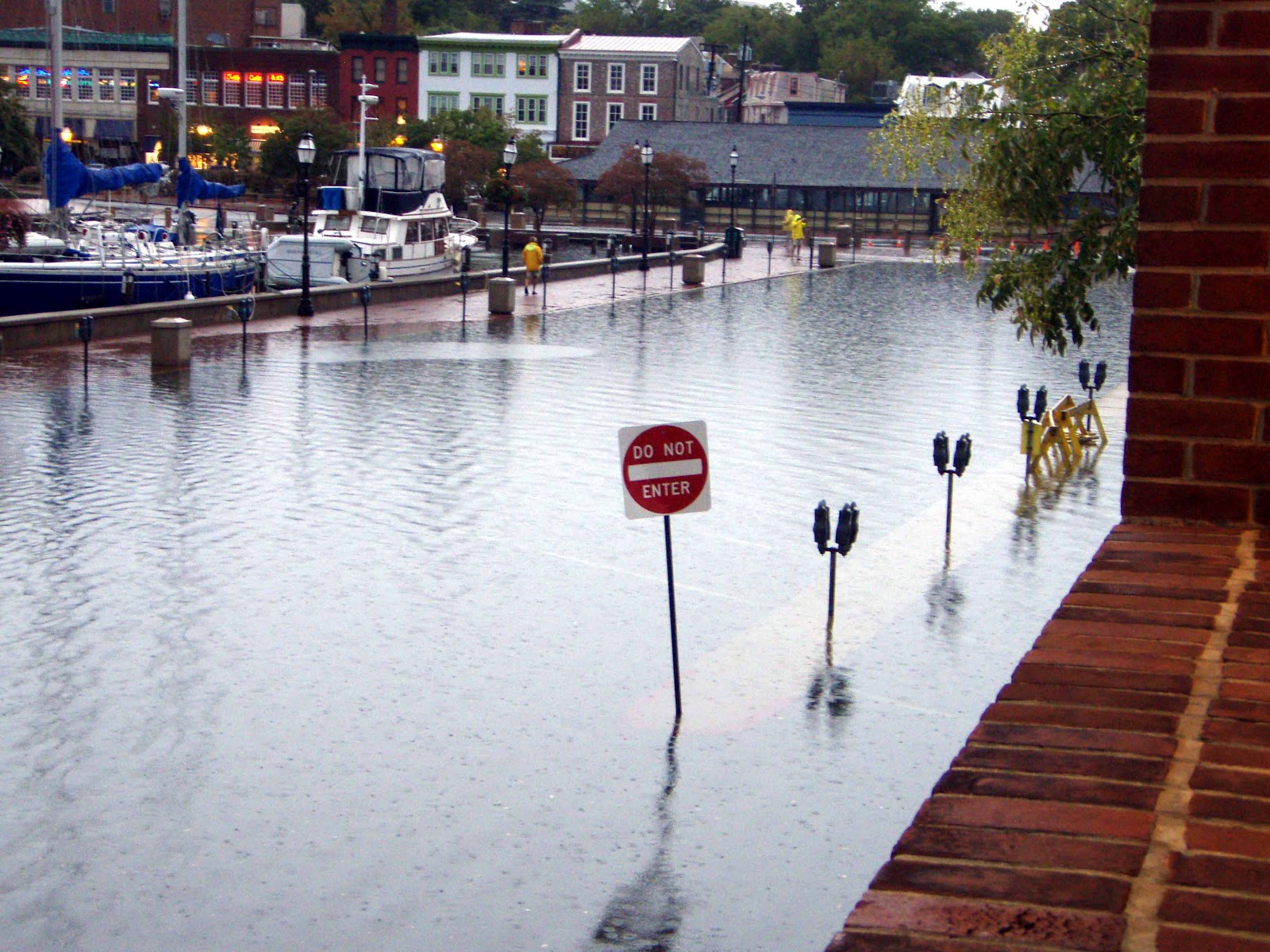
The weather is taking a turn for the worse, so we anchor in a secluded creek off the Severn and enjoy a sunset accompanied by the sounds of ospreys and herons.  The next morning it is blowing stinkers, so we make our way back to mooring field in Annapolis to wait out the blow.  The combination of high winds from the southwest and an unusually high tide result in flooding and the closure of some streets and sidewalks, a phenomenon we have heard about but never witnessed in Annapolis. 
Flooding along the Annapolis waterfront


We are now back on our own again.  It’s time for errands and boat chores.  Burt is making improvements in the electric system in anticipation of adding solar panels in a couple of months and rebuilding a head. I’m doing laundry, bookkeeping, and scraping some peeling varnish. But it’s not all drudgery – cruising friends have pulled up to a ball near us, and we spend several evening visiting with them.  In the past year, our list of cruising friends has grown astronomically – we rejoice at the reunions but feel sadness as we eventually part ways.

And finally, it is a football Saturday here in Annapolis.  The Academy is playing VMI, and there are still tickets available.  So, we hop on our bikes and weave through all the traffic to the stadium where we score general admission tickets.  That gets you the right to sit on a sloping lawn in the end zone corners. These might not be the best seats in the house but they are cheap, roomy, and in the shade which is a pretty good deal on a hot, sunny afternoon.  We are used to Big Ten football with all its hoopla, but the military takes it one step further.  While the band may not be quite as big, neither Michigan nor Ohio State can order up two F-18’s to scream over the stadium right before kick-off.
Two dots in the sky are the jets - and they do make a lot of noise
The Midshipmen march into the stadium


There are plenty of other traditions on display and, best of all, the Midshipmen come out victorious. 

Shortly we will leave Annapolis to travel 15 nm south to the Rhode River and the site of this year’s Seven Seas Cruisers Annapolis Gam.  We have volunteered to help with the set up, and following the Gam, will return to Annapolis to attend the first few days of the annual boat show. After that it’s off to warmer waters.

Tuesday, September 4, 2012

Back to Civilization


It is a short hop through dense fog south to Boston.  The channel weaves through outlying islands and shoals.  Our fog horn is blaring, we are motoring at low speed, and our eyes are alternately glued to the radar and squinting through the fog to discern other boats. It is a bit intimidating.  At one point we see a large ferry boat lurking in the fog, not moving, and just outside the channel. On VHF Channel #16 we are hearing a pan-pan for a ferry that ran aground, but we understand them to be off Marblehead, quite a distance away.  Later we find out that the ferry we saw was the one that had run aground, just before we passed by.  Had the location of the ferry been correctly transmitted, we would have been the first rescue vessel on the scene.  On the way into Boston Harbor, Coast Guard vessels, fire boats, and other ferries are speeding past us, and happily all the passengers are safely transported back to Boston.  Later that day, after the tide rises, the humiliated ferry boat limps back to Boston.

Once we get to downtown Boston, the fog has lifted and it is a glorious, blue sky day.  We pick up a mooring ball right off downtown accompanied by our friends from Australia – we are almost in the shadows of the skyscrapers.   
Sunrise at Boston Harbor - our friends' boat is the white one

We have one and one-half days to see all of Boston so our friends are in for a stretch of “power tourism” American style.  We hit the ground running, well, actually walking on the Freedom Trail.  It weaves through the modern city to most of the interesting historical sights. We visit Faneuil Hall, the Old State House, and the Old South Meeting House, all places where the events of the revolution were hatched. John Adams, Benjamin Franklin, Sam Adams, John Hancock, and Paul Revere all walked these halls. The Boston Tea Party was planned at the Old South Meeting House, and the Boston Massacre occurred steps away from the Old State House. 
Old South Meeting House where the Boston Tea Party got its start

We wander through Boston Commons, a park, and on to the Beacon Hill neighborhood which is graced by many restored row houses.  
Gracious Beacon Hill town house
 
 
The next morning we take the dinghies through a lock which controls tides and into the Charles River. It is a five mile motor through placid waters past parks, boat houses and universities that line the shore.   
MIT's Boathouse on the Charles River

We pass MIT and Boston University on our way to Harvard. There is no dinghy dock available so the dinghies are locked to a railing along the shore, and we trample through a weedy area to reach the sidewalk.  With the mud and burrs brushed off, we regain our dignity, and walk onto the grounds of this bastion of higher education.  Harvard Yard is lush and shady and lined with lovely classical brick buildings. 
The Chapel at Harvard University

Although the students have not yet arrived for the fall semester, it is still a beehive of activity.  On the dinghy ride back, we are passed by sculls and pleasure boats – everyone is out enjoying this beautiful late summer day. 

After a quick lunch on the boat, we resume our trek on the Freedom Trail.  Our next destination is Paul Revere’s house, but we manage to get lost in the winding and confusing streets of Boston’s North End.  And the streets are packed.  This is the festival of St. Anthony and St. Lucia in the predominately Italian section of town.  We crowd on to the sidewalks as a parade like procession passes by in the street.  There is a band and a statue of one of the Saints held high and adorned with streamers and many dollars pinned to the statue’s robe and the streamers.  
Festival in Boston's North End

 The parade moves on although we hear the hub-bub long after it is out of sight. We finally find Paul Revere’s home, a well restored building squeezed in between other older homes and shops.  It gives us a sense of what life was like in 18th century Boston. 
Paul Revere's home

Just down the street is the Old North Church, home of those famous “one if by sea, two if by land” lanterns.  It, too, has been beautifully restored and is still in use as a church today.  
Old North Church


Our final destination takes us across the Charles River to the home of the Constitution, the oldest commissioned ship in the US Navy.   
The Constitution - too big to fit into the picture frame!

Yes, she is still manned by the Navy and just the week before, she hoisted sails for a short journey through Boston Harbor. Recently restored in anticipation of War of 1812 commemorative events, everything in the boat is historically correct and as original as possible.  The only modern additions are electric running lights and electric bilge pumps.   
And those electric bilge pumps? Built by Gorman-Rupp from our home town of Mansfield, Ohio

We go through extensive security to go aboard and are guided by naval personnel. 

We have worn out our Australian friends, but that’s OK as we are spending the next day sailing to Provincetown to await appropriate winds and currents to make the passage through the Cape Cod Canal.  Two days later with favorable winds and currents we have a glorious 85 nm sail to Bristol, Rhode Island in Narragansett Bay. At one point we hit 11 knots, far beyond our calculated hull speed. We have been in Bristol before, but not by boat. Besides its famous Herreshoff Museum which we visited a few years ago, Bristol has a lovely bike path that extends all the way to Providence and a number of attractive restored homes of wealthy sea captains. 
Captain's home in Bristol


We are twiddling our thumbs, first at Bristol and then back at Newport, as there is a threat of hurricanes in our stretch of the Atlantic. This gives us several days to do repairs, provision, do laundry, and enjoy our surroundings.  Bryan and Beth pay us a visit, and we take a scenic hike with them along a point of land east of Newport that is part of the National Park System. 
Beth, Bryan, and Burt hiking amongst the rocks at Sachuest Point

Our anchorage at the entrance to Newport Harbor is the perfect vantage point for viewing the many classic yachts entered in the annual Labor Day Classic Boat Regatta. There are over 50 boats participating in this International Event and at one point they all parade past our bow and through the anchorage area on the way to the reviewing/judging stands. 
The 12-meter American Eagle leading the boat parade with a bagpiper playing on the bow.

We need our sunglasses as the glare off the varnish work is so bright – one appreciates the willingness of others to maintain such beautiful yachts. Outside the harbor and under sail, we see everything from wooden twelve meters, to classic one designs, to ocean worthy large ketches, gaff rigged sloops, and schooners.
Herreshoff designed gaff rigged sloop

 Nearby the race course, restored motor yachts provide a viewing platform for their owners. 
Elegant restored motor launch


So now we wait. What sort of torrential rains will we receive from Issac?  How high will the ocean swells be that Kirk produces?  Where exactly will Leslie’s track be? And another tropical depression named Michael just popped up. Our trip south to the Delaware Bay entrance is about 240 nm of open ocean sailing, and we don’t want any surprises along the way. So…the thumbs keep twiddling.

Friday, August 24, 2012

Heading Up West (?)


If the inverse of “Down East”, the direction we have been traveling for almost a month, is “Up West”, that must be where we are headed.  We have a decent stretch of weather with winds not exclusively out of the southwest, so it seems prudent to begin the trip south.  Leaving Mount Desert is difficult as we have enjoyed it so much.  We feel a bit melancholy, and others with whom we are occasionally cruising say the same.  So, we take a small hop just four miles south to Little Cranberry Island.  This small island is one of only a handful of Maine islands that are inhabited year round.  Here there are few facilities for tourists, and the harbor is full of lobster boats.  
Waterfront at Little Cranberry Island

 Biking through the island, we find the mosquitoes out-number the residents exponentially; it is a true blood letting, and we beat a hasty retreat back to the boat despite the efforts of the proprietor of the local restaurant, armed with various bug sprays, who wants us to stay for dinner. We are safe from the little monsters on the boat and enjoy a beautiful view northwards towards Mt. Desert. 
Our final view of Mt. Desert Island


The next day we have a glorious sail through the Deer Island Thorofare, a rock strewn and relatively narrow passage between islands.   

Vistas along the Deer Island Thorofare


Upon entering Penobscot Bay we find ourselves sailing along with one of the classic Maine schooners that ply these waters. 
We're crossing tacks with this beauty

Our overnight is in Pulpit Harbor, a protected but crowded anchorage on the east side of North Haven Island. Just after dropping the anchor, a huge schooner arrives in the harbor and somehow shoe-horns herself in next to us. 
And our neighbor in Pulpit Harbor

We have one last evening happy hour with three other couples we have been with off and on; we are all heading in different directions now.  A layover day in Rockland gives us the opportunity to re-provision, do laundry, and pick up fuel for the trip south.

An early departure the next morning takes us out of Penobscot Bay along coast line we never saw when we came in in a dense fog.  Maine is certainly gorgeous when you can see it, although we are still cursing the numerous lobster pots. 
Lighthouse on a rocky isle along the Atlantic coast

Our next destination is Linekin Bay, the site of my earlier experiences in Maine.  Back in the late 1950’s my family vacationed at the Linekin Bay Camp, a rustic resort that focused on small boat sailing. This is where I had my first real experiences sailing, and I want to return to see if it is still as I had remembered.  The bay is much more developed, moose do not roam in the woods, and all the wooden boats have been replaced by fiberglass Rhodes 19’s, but otherwise it was quite the same and, happily, well maintained.  We enjoy a dinner at their deck restaurant overlooking the bay. 
Linekin Bay Camp


From Linekin Bay it is a short hop to Boothbay, but we do it via a detour to Squirrel Island which lies just outside the bay.  Squirrel Island is privately owned and the home of many large, well maintained “cottages” dating from the late 1800’s. Fortunately, the island provides a free visitor mooring, and we are welcomed ashore by fifth generation residents that point us in the direction of a few interesting sights. There are no cars or bikes allowed on the island; instead there are numerous walking paths, both concrete and boardwalks constructed out of teak, that go along the rocky cliffs and between all the homes. 
The walking paths at Squirrel Island

Community facilities include a tea room, now closed for the season, a library, a non-denominational church, a small museum, a post office (only open 6 hours per week), and five beautiful tennis courts that were once home to the US Lawn Tennis Tournament, probably about 100 years ago. 
Church for the community at Squirrel Island

Someone lets it slip that Morgan Freeman was recently there, so you get the gist. We head into Boothbay for the night.  The town is a bit too touristy for us, but we do rendezvous with our Australian friends for the cruise further south.

The beautiful weather is holding up, and we have an enjoyable sail down to Jewell Island in the outer reaches of Casco Bay. 
Another one of the many lighthouses along the Maine coast

Jewell is an unimproved Maine State Park, and we drop anchor in a narrow harbor and scamper ashore to do some hiking.  The island once hosted a World War II outpost responsible for sighting enemy ships and submarines off the coast and calling in guns and destroyers to deal with the threat to Portland. We climb a remaining observation tower and are rewarded with a panoramic view of Casco Bay.   
View from the tower on Jewell Island overlooking other islands in Casco Bay

There are many other trails that beckon us to walk through fern and moss carpeted forests and along rocky shorelines.  
The rocky coast along Jewell Island

 We spend too long in this land of ten foot tides and return to find our dinghies high and dry, a long way up the shore. Looks like the guys have a bit of a problem on their hands!

Andrew and Burt contemplate our dinghy predicament


Another hop takes us further down the coast to the Isles of Shoals, a group of rocky islands about five miles to sea from Portsmouth, New Hampshire. We tie up at buoys maintained by the Portsmouth Yacht Club. A gentleman on one of the neighboring boats tells us that with the southern breeze, we are in Maine, but if the wind shifts to the north we will be in New Hampshire. We head ashore to explore Star Island, one of the many isles.  It features a huge old, historic hotel that is now home to a conference center for the Unitarian Church.  We are allowed to walk through the rickety hotel (no smoking allowed, for obvious reasons) and along their many hiking paths.  The view over the ocean and into the harbor is spectacular.   
The anchorage at Isles of Shoals

Across the way, on another island, is a marine research center operated by Cornell University and the University of New Hampshire.  We would like to visit the facilities, but it requires advanced reservations, so that will have to await another trip.

Our final stop is in Beverly, MA at a yacht club where friends we made in the Bahamas are members.  It is a good opportunity to pick up a mooring, do a little cleaning and maintenance, and make arrangements to visit Boston, just a short hop south.