Friday, March 22, 2013

Inching a Bit Further South


Regatta time in George Town is past history except for one last event.  Each year a sailing rally is organized to go to Long Island, the next island south of the Exuma chain.  With around thirty boats signed up, we leave George Town harbor, heading out the southeastern cut from protected Elizabeth Harbor.  After several days of massive northerly ocean swells, it is judged safe to depart.  It may be safe, but it still has an element of excitement.  We weave our way through reefs where the swells are crashing unnervingly close to our track. Below decks, the contents of our boat are being rearranged as we bounce through the surf. “Be careful opening the storage bins as the contents may have shifted during flight” seems to apply here.  Once we get into the deep ocean waters, the swells become barely perceptible. With virtually no wind, our supposed sailing race gets postponed, and the fleet motors down to Thompson Bay on Long Island. 

This huge influx of cruising boats to Long Island is seen as an economic boost to this otherwise quiet and often overlooked destination.  The tourist council has many activities planned for our stay.  Our group fills two school buses, and we take a tour of the southern portion of the island.  We did a similar tour last year, but decide to do it again as it provides an inexpensive way to see the many small settlements. Stops include the picturesque Sts. Peter and Paul Catholic Church in Clarence Town, built by the locally famous Father Jerome, 
Exterior and interior of the simple but exquisite church


The sign says it all


and Dean’s Blue Hole where the world free diving championships are held. 
Dean's Blue Hole with the pounding surf on the ocean side


When we stop by the Long Island Historical Museum, the local People to People organization holds a tea featuring traditional bush teas.  We sample the teas, learn about their medicinal applications, and meet friendly Long Island residents who chat about their island existence and culture. The tour concludes with a rum drink at the famous Max’s Conch Bar.

That evening Long Island Breeze Resort, a small cruiser-friendly restaurant and bar overlooking the anchorage, sponsors a sunset Happy Hour.  Music is provided by several cruisers including our favorite keyboard artist who we originally met in Marathon. 
Music on the deck of Long Island Breeze

A number of non-cruisers, including winter residents and Long Island natives, join the crowd. The ambiance is magical, and everyone lingers way past sunset.
Sunset at the Breeze, overlooking the anchorage


Since there was no wind for our scheduled race to Long Island, a make up race is planned for Saturday morning.  Rally racing is supposed to be fun and not overly competitive, so instead of a standard start with all the boats on the starting line at the same time, the committee just takes our starting time when we get around to crossing the line.  Twenty boats participate, sailing on a reach for four miles out from the harbor and then returning to the starting (now finish) line. The wind is blowing close to 20 knots and the seas are flat making it a perfect sail – we are flying, averaging speeds close to 8 knots!  Even better, we come in second in our fleet.  If we had only remembered to feather our prop before the race was almost half over, we might have done even better.  But this is a fun race and lapses by the crew are a foregone conclusion.

That evening, we have a group dinner at the Breeze, a trophy presentation, and a dance DJ’ed by fellow cruisers “Rocking Ron and Kool Karen”. Prior to the official event, local artisans set up a display their creations – straw work and baskets, jewelry made from shells and beach glass, paintings, sculptures in shells, and some very tasty jams – all of which are reasonably priced and of a high quality. In the midst of all the activity, one of the guides from yesterday’s bus tour shows up with his Junkanoo band for a rush out. To the accompaniment of horns, whistles, cow bells, and a variety of drums, the group descends on the Breeze.  The pounding rhythms and energetic dancing get everyone bouncing along. Junkanoo has its root in African culture and has become a staple in Bahamian communities.  The primary rush outs occur around New Years, but the locals are happy to have other opportunities to play and dance, and we enjoy another sampling of traditional Bahamian culture. 
Our tour guide, Omar, in the traditional crepe paper pants, leads his cru


The next morning most of the cruisers leave Thompson Bay for other destinations.  We decide to head to the north end of Long Island where we anchor in picturesque Calabash Bay.  The several mile long bay is anchored by the upscale Cape Santa Maria Resort and a number of ex-patriots’ large vacation homes. We take a lengthy walk along the powdery sand beach, gazing out on the turquoise water and many sand bores. 
Calabash Bay with the resort in the distance

That evening we dinghy over to the resort for dinner in their lovely two story screened in dining pavilion. Other anchored boats do the same, and in the bar, before dinner, we are introduced to Dave Calvert who lives about twenty miles further north on Cat Island. The name may mean nothing to most people, but Dave is an internationally known multihull racer and is the sailmaker who designed and built the sails we had on our previous boat.  It truly is a small world.

From Long Island, we head east to remote Conception Island.  The wind has picked up, and we find ourselves on a 30 mile beat to windward.  It is a bumpy but exhilarating ride, and once again, the contents of our cupboards below deck are being rearranged.  Conception is a small, uninhabited island that is in the national park system.  It rises from the ocean depths very dramatically with the sapphire colored ocean waters suddenly changing into a variety of turquoise hues. 
The beach at Conception near the anchorage

It is a place to visit only during settled weather as the anchorage has very little protection from any winds other than the trades.  Our arrival at Conception coincides with Burt’s birthday.  Friends circulate that information and plan a birthday celebration for the beach that evening. It is a birthday Burt will never forget, spent on one of the most beautiful beaches in the world in the company of new and old friends. Music, including the birthday song, is provided by Valerie and Ray from a large yacht in the anchorage.  They are professional recording artists that we originally met this winter in Marathon.
Burt celebrates his birthday at a very special location


The weather window allows us to stay an additional day, and we enjoy hiking to the windward side of the island with its equally spectacular sand beach. 
A calm day on the windward side of conception Island

Overhead, the migratory tropic birds with their flowing, long white tails are circling, indicating the spring is arriving in the southern Bahamas. When we tire of hiking, we return to the boat to spend the rest of the day soaking in the beauty of this special place.  The following day west winds are forecast, so we debate our next destination.  Do we head north to Cat Island with it exposed anchorages or return to George Town and the safety of Elizabeth Harbor? Our weather forecasting service indicates that the stormy weather being experienced on the US east coast will trickle down our way with the possibility of two more weeks of unsettled weather.  We wake up that morning to dark clouds and squalls on the horizon and quickly head out to sea as we don’t want to be caught in the anchorage with a squall. Thus, we begin the trek back to George Town.  With unusually strong cold fronts forecast to pass through the northern and central Bahamas in the coming weeks, we will opt to stay south where conditions will be relatively milder.

Monday, March 11, 2013

Life in the Big City


Compared to all the other towns in the Exumas, George Town is the big city. No, there are no stop lights and a one lane dusty road encircles the town, but we can find most of what one might need here, and there is even an international airport nearby. To access town one enters through a narrow cut into Lake Victoria and ties up at the dinghy dock provided by Exuma Market.  Multiple stops to the BTC office and J&K Productions (Julius and Krystal – a computer store in a shack with a dusty concrete floor and no glass in the windows where they really do know how to fix computers and phones - better than anyone in Nassau) get us a Zoom air card and finally some access to the internet on our computer. We can reprovision at the Exuma Market, a crowded grocery with narrow aisles, the only true grocery store on the entire 60 mile long island. There’s a bank with an ATM machine, one of only two in the entire Exumas. Lee who runs the Corner Laundry welcomes us back; she has an incredible memory for names and faces. The facility has seen better days but it gets the job done, and we leave with bags full of clean laundry.  Also along the road you will find a hair salon that also sells fresh fish and lobster, an upscale gift/art shop, several liquor stores, a gas station, and several restaurants that run the gambit from casual Bahamian carry out to high end dining.  It is certainly a study in contrasts and you know you are no longer in Kansas, Dorothy.

Life in George Town and the surrounding harbor is anything but boring.   
Our anchorage just off the Chat and Chill beach
Rainbow viewed from the anchorage
 
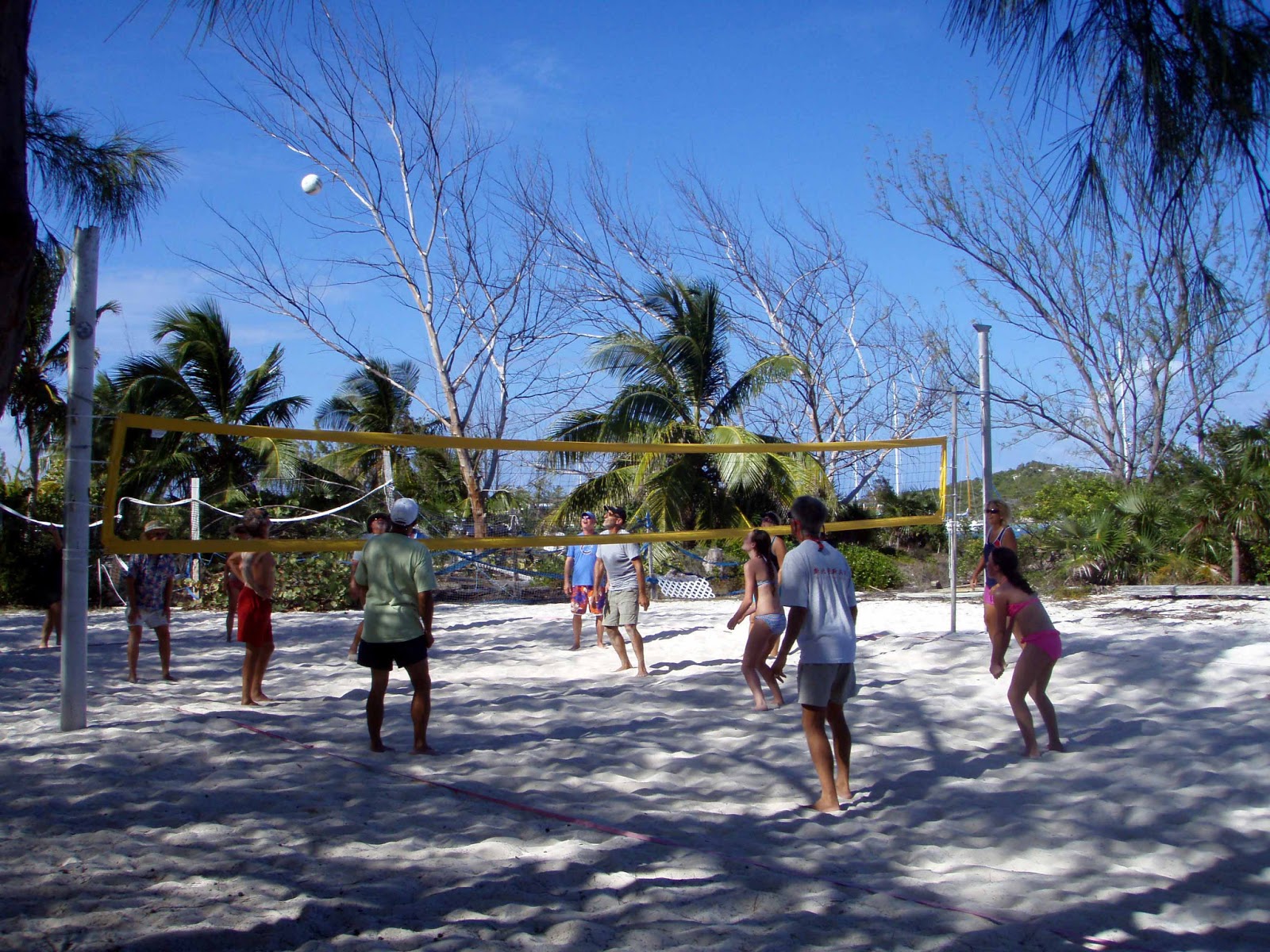
With so many cruisers here, 280 boats at latest count, there is no shortage of available activities.  The morning cruisers’ net on the VHF radio broadcasts the daily options that are available. Burt plays volleyball at the nearby beach bar almost everyday. 
Volleyball on the Chat and Chill beach - it is amazing no one gets hurt!

I go to Yoga on the beach under the trees some mornings and do water walking along the sandy shore with a group several afternoons a week. We take the dinghy to some of the beach access points on Stocking Island and hike along the well maintained trails to the spectacular shoreline along the Atlantic coast. 
Not a bad view for a hike

As the not very official basketweaving instructor, I occupy a picnic table near the volleyball courts most afternoons, giving instruction to beginners while also working on my own projects.   
Burt helps harvest some Silver Palm fronds that we use in basketmaking

On Sunday mornings we attend beach church under the whispering pines and Sunday evenings we go to Trivia Night at the St. Francis Resort, where one night we actually win, our team consisting of ourselves and the Babsons who hail from our area of Lake Erie. Many nights there are bonefires on some of the nearby beaches, Rake and Scrape dances in town, and happy hours with friends on boats. One night we attend a jam session at nearby beach bar where we hear a very talented keyboardist who we originally met in Marathon.  And, sometimes you just need a break from all the activity.

But if you are longing for peace and quiet, Regatta time in George Town is NOT the place to be.  For ten packed days, the cruisers put on a slew of activities ranging from big and small boat racing, a Bahamians vs. cruisers softball game, volleyball tournaments, dances, and a variety of sillier events.  We limit our participation to a manageable amount of activities.  Burt is helping on the race committee for the big boat races and is on a team in the Fun Volleyball Tournament. 
Some of the racers cut it pretty close to our boat

We join in on the Poker Run which is basically an afternoon spent visiting five beach bars and resorts by dinghy where we sample their food and drink and pick up the cards for a poker hand. It a fun and sociable way to pass an afternoon, and no one seems to care which of the 52 dinghies actually wins when the poker hands are revealed. And finally, there are the evening events – Opening Night with a Cruisers’ Talent(?) Show and dancing under the stars on the sandy beach and Closing Night with door prizes and more dancing.
The Conch Band at the Talent Show really sounded more like a herd of dying elephants
  

One day we rent a car with another couple and drive the entire length of Great Exuma Island and Little Exuma Island, a distance of over 60 miles.  We see a mix of native small communities and resort properties. We stop along the way to see loyalist plantation ruins, several century old tombs, and a monument to the leader behind a slave revolt. 
Ruins of a loyalist plantation

Beautiful beaches abound, and one even features a cave where an ex-pat lived the life of a hermit for several years. At the farthest southeast point on Little Exuma Island, we stop for lunch at Santana’s Grill, a very simple roadside, outdoor restaurant. Burt claims it is the best traditional Bahamian meal he has ever eaten, and the view isn’t too bad either. 
Open air kitchen at Santana's
Joined by friends Al and Arlene, we look like we're having a good time at this scenic restaurant

Next door is Mom’s Bakery.  Mom is a legend in the Exumas as daily she baked up to a hundred loaves of bread and trucked them 30 miles to George Town. These days, her health has dramatically cut into her business, but we find her slogan “A hug with every loaf of bread” is still in practice as we patronize her shop.
Mom shows off her wares - just another of the delightful Bahamians we have encountered

Nearby we stop to see the large stone pillar that acted as a navigation mark for ships approaching the salt flats that were actively “mined” by the British as early as the 1670’s. 
The Doric column used as an aid to navigation during the salt trade

And just down the street we find the beautiful and secluded Tropic of Cancer Beach. 
The secluded Tropic of Cancer beach - note the lack of people

Yes, we have crossed into the Tropic of Cancer, a milestone for cruisers that spent the summer in Maine.   

Back in George Town the cruising season is beginning to draw to a close. All of a sudden, gulls and song birds appear and locals tell us that is a sign of Spring. People are talking of plans to head further south to the Caribbean or north towards homes or other cruising grounds. Seminars are given on Caribbean cruising areas and passage routes, outboard repair, and other topics that allow cruisers to become self-sufficient in remote areas.  A local man comes on Sunday afternoons and gives talks on Exuma history and culture under the pines at Chat and Chill.  To celebrate the beginning of daylight savings, Chat and Chill supplements its weekly pig roast with a local band playing native music well into the evening.  The melodies float through the anchorage.  A large group gathers at one of the beaches for a going away party for a couple who have wintered in George Town for the last 26 years. They are remembered for all they have done for the community including developing the extensive network of hiking trails on Stocking Island and beginning Beach Church.  After returning to the States, they will sell their boat and move into a new home.  Thus, the circle of cruising life goes on.

The gathering on the beach at Monument Hill honoring Skip and Cheryl
While we may be preparing to leave, Mother Nature has other ideas. For the past month, strong lows along the US Atlantic coast and their resultant cold fronts have played havoc with our weather.  Now gales off the Carolinas are sending record ocean swells our way.  The wind may not be that strong, but the crashing waves along the Atlantic exposures make exiting cuts into the open water nothing short of treacherous. 
Crashing waves along the Atlantic side of Stocking Island
More waves crashing into the ocean shore iron rock
The waves form a waterfall through the rock into what we call our hot tub

Everyone’s plans are put on hold until the seas subside and winds begin to blow in an advantageous direction.

Sunday, February 17, 2013

Bahamas Bound – Year 2


We are waiting patiently for appropriate weather to head to the Bahamas, but the weather gods have other ideas sending us strong persistent easterly winds- a bad idea if you are trying to head east in a sail boat.  Thus, the activities at Marathon continue to occupy our time.  We enjoy more seminars, meals out, and evenings of music.  One afternoon I take a class in jewelry making.  Someone on the morning net remembers having Wednesday evening “meet and greets” in previous years, so Burt and I agree to host the first one of the season.  Name tags seem like a good idea, but finding them in Marathon proves to be a challenge. Ten miles of biking later, we return with the name tags, and the evening proves to be a success.
Just befor sunset under the Tiki Hut


We take a cab with friends to the Dolphin Research Center about ten miles away.  Upon entering, it becomes immediately apparent that we are not at Sea World.  This is a much smaller venue with an emphasis on research and husbanding healthy pods of captive dolphins.  We are able to get close to the pens and watch the trainers and caretakers at their daily tasks. Yes, there is an entertainment aspect as this is what funds the center, but its purpose extends much further.  The trainers take time to talk personally with us, explaining what they and others are doing.  We watch their veterinarian take ultrasounds of the dolphins, something that is done on a monthly basis, and while we are there, they discover two of the females are pregnant.  And speaking of pregnancy, since there is concern about maintaining a strong gene pool among captive dolphins, we watch a sperm collection that will be used for artificial insemination. Obviously, nothing is done behind the scenes! We get close to some of the dolphins who especially enjoy human contact, talking and making gestures to them – they seem to respond back to us in kind.  There is a quasi show with some of the larger dolphins showing off their jumping skills, 
One of the big boys struts his stuff

but we also see less structured play time with water showers, balls, toss toys, and chasing trainers along the perimeter of the pool. Dolphins need the relaxation and creative stimulus of play.  
The dolphins play just like a small child would

How do dolphins sleep? Since they are conscious breathers (they need to think about breathing), only one side of their brain and body can sleep at a time.  Close up we observe a dolphin with one eye open and one eye closed, rolling side to side to keep an eye on what is happening above and below him  - that’s how dolphins sleep. We are told that during hurricanes, the dolphins are released to the open, deeper waters as this is their natural preference.  When the storms pass, they return to their pens by choice as they seem to realize they really do not have the learned skills to survive in the wild over long periods of time. And finally, we see a very interesting research project where several dolphins are displaying their ability to discern less from more.  Two panels are presented with an array of different sizes and quantities of dots.  The dolphins study the panels and then pick the one with the fewer dots. No one knows exactly how they accomplish this, but it implies that they have some level of number sense – fascinating. I could have spent hours watching these beautiful and interesting creatures, but sadly, closing time comes all too soon.

Finally we get the weather forecast that we want for the long trip east. Super Bowl Sunday is our last day in Marathon, and we are invited to friends’ trawler for dinner and the game. Life on a trawler is much more civilized than a sailboat.  We sit in actual living room furniture and watch the game on an actual TV with a satellite feed. We are in the lap of luxury and appreciate this fun farewell from these good friends we met over a year ago.

Early Monday morning we raise the dinghy onto the foredeck and deploy our jacklines.  Although the forecast is for calm motoring the entire 220 nautical miles to Nassau, we prepare the boat as if we might see some serious weather.  The motor east in Hawk Channel is uneventful, but lovely with the multihued turquoise water. Uneventful except that early on, we run over a crab pot float, something that ordinarily would cause the line to wrap around the prop and kill the engine. But, it is our lucky day as all we see in our wake is some shredded styrofoam.  Forty miles east of Marathon, we cross over the barrier reef and head towards the Gulf Stream.  Chris Parker, our weather forecasting guru, says that three hours after winds drop and change direction at the Fowley Rocks weather buoy, the Gulf Stream would lay down.  It is now five hours after that change, and we find Chris’s typically accurate predictions aren’t spot on this time.  We have no wind but the short period waves are coming from all directions.  It is really unpleasant, and Burt and I take seasickness meds for the first time in our memory.  Somehow we get through the night and enter the Great Bahama Banks at dawn.  Only then does the motoring become comfortable.  We have a sixty mile transit across this plateau of water, no deeper than 15 feet, that rises from ocean waters thousands of meters deep.  We see no land and no other vessels. At sunset we enter the Tongue of the Ocean, a trench of extremely deep water on the east side of the banks.  We drop anchor at the southeast corner of the Berry Islands, on the north side of the Tongue, to catch a little sleep.  The stars are amazing, packing every square inch of the dark night sky – there is no ambient light in this area of the world.  The next morning we make the final hop to Nassau with sails unfurled as there is enough wind to finally do some motor sailing. 

Entering Nassau is a bit intimidating - you must get permission from Harbor Control and then encounter some preeeety big ships


Nassau is not a very appealing destination; it is a place where you arrive, take care of necessary business, and leave as soon as possible.  Crime is rampant, so most of the city is off limits, and no one goes out of the guarded marina at night.  After none months away from the Bahamas, we realize we have lost our ability to decipher the Bahamian dialect and are constantly saying “Pardon me” when talking with the locals, making us feel and perhaps look a bit foolish. We clear into customs, asking for a 120 day permit and receive a 150 day permit – go figure as usually you get less than the number of days requested.  We do a few quick errands and visit BTC (Bahamas Telephone Company) several times to get our phone and data plan changed over. It is a frustrating process, and we still do not have it totally operational. Since we crossed to the Bahamas in an unusually good window, we are joined at the marina by many other boats that crossed in the same time frame. The boaters organize a happy hour along side the pool, and we see all the faces that correspond with the voices we have been hearing over the radio the past days.

The good weather holds, and we head further east to Highbourne Cay and the north end of the Exuma chain.  There is no tarrying, though, as a front is forecasted to come through. The next day we have a great sail down to Warderick Wells and the headquarters of the Exuma Land and Sea Park, a Bahamian National Park.  The mooring ball field there is well protected and a great place to ride out a blow.  We are just in time for the weekly happy hour organized by the park.  Gathering under the beach front tiki hut, we visit with old and new friends while gazing over the spectacular scenery. 
Sunset on the beach in the Exuma Land and Sea National Park

We have been away from the Bahamas almost nine months and have forgotten how beautiful the water and beaches can be.  Come dusk, we are joined on the beach by some of the resident hutias, a rare nocturnal rodent similar to guinea pigs.  They seem oblivious to the humans and focus in on the snacks that have found their way to the ground. 

The nocturnal guests at Happy Hour


Due to the weather, we will be in Warderick Wells for several days, and we spend our time enjoying this special setting.  
The protected mooring field at Warderick Wells

 Hiking trails take us along ridges overlooking the crashing waves of Exuma Sound and across beaches where the sand is powdery soft.  
Spectacular hiking along the Exuma Sound coast at Warderick Wells

 Everywhere we come across the plentiful curly tailed lizards that peek out at us with curiosity. 
Tame Curly Tailed Lizards are on all the hiking trails

We snorkel off the back of our boat as we are moored right next to one of the most popular snorkeling sites.  Amongst the corals are tropical fish of all varieties. We see a large spotted eagle ray gracefully swim by. And, when we return to the boat, we find a three foot sharksucker attached to our keel.  Apparently, we are growing some very tasty algae down there.

Moderating winds entice us to head further south.  We have a fantastic beat to windward down to the small settlement of Staniel Cay and its anchorage at Big Majors Spot.  We spent quite a bit of time here last year, so we skip some of the common attractions such as the swimming pigs, and instead spent the rest of our afternoon snorkeling the grotto where the James Bond film Thunderball was partially filmed.  We feed bread crumbs to the school of sergeant majors and find ourselves in the midst of a huge feeding frenzy with the fish bumping into our masks.  The corals here are spectacular; many are virtually neon colored in tones of green, yellow, red, and lavender. We spend the next morning taking the dinghy to the rocky shore of Exuma Sound and hiking the jagged cliffs. 
Rocky shoreline of Staniel Cay

Crashing waves of Exuma sound

View from the cliffs

And, in the distance we see the approaching island freighter, the Captain C. 
Unloading the precious cargo from Capt. C, a typical inter-island freighteer

 That means only one thing – in a couple of hours Isles General Store will have fresh vegetables and fruit.  We plan the remainder of the day around replenishing our supplies as fresh food is so hard to come by in the Out Islands.

Our latest email forecast from Chris Parker gets our attention.  When Chris puts phrases in all caps, we take things pretty seriously.  A strong cold front, a result of the severe weather being experienced in the States, will pass through the Bahamas with potentially gale force winds from several directions, requiring an anchorage with all around protection. Due to our deep draft of almost seven feet, our possibilities are limited.  We make the decision to head to Georgetown at the southern end of the Exuma chain.  We are skipping many enjoyable destinations in our rush to get protection, but we hope to head back this way when the long term weather patterns seem more settled.

We have a beautiful motor / motorsail / sail for 60 miles down the Exuma chain in sapphire colored waters. Coming into Georgetown is a bit like coming home.  We know many of the boats that spend the entire winter here and are amazed at how many new boats also occupy the harbor.  With over 250 boats anchored along a several mile stretch of Stocking Island, this shouldn’t be a surprise.  We arrive late afternoon on Valentine’s Day and have just enough time to get showers, eat a quick dinner, and head over to Chat and Chill, the local beach bar, for the Valentines dance.  The place is hopping and the dance floor is packed with “Rocking Ron” and “Kool Karen”, friends from Vero Beach, playing disc jockey. The next day we head into Georgetown proper to do laundry, consult about our internet problems, and visit Exuma Market, a fairly adequate grocery store.  With the coming heavy weather, we will be unable to get to town for a number of days. That evening we attend our first meeting of ARGggg (Alcohol Research Group), otherwise known as Happy Hour at Hamburger Beach. Powdery soft sand rimming turquoise water and a beautiful sunset make this an ideal setting.

The foul weather is due to arrive the next afternoon.  Boats reposition, anchors are checked, deck gear is tied down, already wind shredded flags lowered, and we wait.  One boat goes aground off the beach during a pre-frontal gust, but several dinghies manage to push it off the soft sand so it can reset further out. At sunset the winds pick up to the mid-20’s accompanied by some higher gusts from a direction where we will have about five miles of open fetch.  It’s a bit bouncy, but the fresh breeze and bobbing of the boat make for some pretty good sleeping conditions.  Having a huge anchor and lots of heavy chain also makes sleeping a bit easier. Once the wind swings more easterly, dinghy access to the beach and all it’s activities will be much easier, and then, life in Georgetown will get back to normal.

Friday, January 25, 2013

The Nostalgia Tour


We are settling into daily life in Marathon.  Boot Key Harbor has over 200 boats on mooring balls and many more at surrounding marinas or at anchor in the shallows.  The harbor is protected from all directions, and, although we are as far away from the community dinghy dock and facilities as one could be, due to our deep draft, it is still a relatively short ride in to the lounge, laundry, bike racks, and showers. Within a mile are a number of restaurants, some accessible by dinghy, West Marine, and a great grocery store. In Marathon, life is easy.

Morning coffee in the hammock chair


In Marathon, life is also busy, and the days fly by.  We get our new bikes via UPS and have them serviced at a local bike shop, so now we have wheels again.  A favorite ride is heading west along a busy US Route 1 on a bike trail to the beginning of the famed Seven Mile Bridge. 
At the end of the Old Seven Mile Bridge with our friend Sally - breakfast at the Stuffed Pig was to follow

Here traffic flies by on the new bridge while a two mile section of the old bridge remains available to walkers and bikers.  We pedal along enjoying vistas in all directions of the milky green waters of the Keys with a multitude of mangrove islands dotting the northern exposures.  If you stop and patiently look into the clear waters below, one can see much aquatic life.  We find tarpon, turtles, nurse sharks, a bonnet head shark (a small relative of the hammerhead shark), and needle fish. The old bridge stops at Pigeon Key, now an historical landmark.  At one time it was a headquarters for Henry Flagler’s construction company which built the original railroad through the Keys.

We take dinghy excursions through Old Woman’s Creek, exploring the canal front neighborhoods and heading out to the ocean side of Marathon and Sombrero Beach, a city public park.  Sitting under a palm tree with our toes in sand is a delightful way to spend an afternoon.

We tour the nearby Turtle Hospital. After a talk on the endangered species of turtles that inhabit these waters, we visit behind the scenes of the hospital.  The operating suites are first class, and we see one turtle in the recovery room.  Medical issues effecting turtles include ensnarement in fishing nets and lines, unfortunate encounters with props and speeding boat hulls, and a peculiar type of tumor. This is one of the few facilities in North American licensed to do surgery on endangered turtles. Outside, at this one time bayside motel is a large salt water swimming pool, now a holding tank for recovering turtles and those turtles that will never be able to be released to the wild. Visitors can feed the turtles, attracting them to the side where we observe the sizable green and loggerhead turtles. Nearby are smaller tanks with turtles isolated and healing from surgery, diseases, or injuries.

This Loggerhead Turtle seemed especially attracted to the visitors


We visit Crane Point Nature Center, a secluded tract of bayside land, right in the middle of Marathon. 
View over Florida Bay from Crane Point

We walk through dense tropical hammock, enjoy vista over Florida Bay, and see the restored home of Bahamian immigrant George Adderley, the oldest home in the Keys outside of Key West. 
Over 100 years old, the Adderley house is similar to ones we still see in the Bahamas

Also in the property is a wild bird rescue center where injured birds are rehabilitated. On display are osprey, hawks, cormorants, and a hoard of pelicans.  We get to pet a pelican and touch its gullet, the thin baggy skin along its neck. 
Pelicans aren't too bright, so there are plenty that get themselves in trouble and need a helping hand.

As a non-profit, Crane Point is struggling financially, and its directors have recently decided to install a zip line through the hammock to generate revenue, causing considerable controversy in Marathon.  

We head out in the boat to Sombrero Reef, about three miles south of Boot Key Harbor. It is an unusually calm day, but we still have a swell coming over the reef which rocks the boat after we tie to one of the sanctuary mooring balls.  Here at the reef we discover two other boats we know that happen to be docked at a nearby marina.  We have a pleasant snorkel on the reef although the clarity of the water does not come close to what we had seen in the Bahamas. With wet suits on, we are sufficiently comfortable to spend almost a half an hour just floating in the water and visiting with our friends.

And, we spend time socializing. Happy hours include rendezvousing with friends we have made along the way and making new friends with a number of mooring neighbors. We venture to the marina Tiki Hut for evening jam sessions with local musicians, and head over to a nearby restaurant for weekly luncheons with the Seven Seas Cruising Association group. 
A portion of the accurate depiction of Ocean Blvd. in Miami Beach made completely from Legos - a quirky feature at the restaurant hosting the SSCA lunch

Some of the more experienced cruisers and local marine service contractors present seminars on technical issues including alternative energy, battery usage, and ham radio, along with several other talks on cruising destinations.  
Over 75 people attending this excellent seminar on cruising the Exumas

It is safe to assume, no one is bored here.

But, in keeping with our title of “The Nostalgia Tour”, we take a week and sail further west to Key West. In protected Hawk’s Channel, the water is a spectacular assortment of greens, with the tones modulated from above by clouds and sunshine, and below by the either sand or sea grass bottom. 
Burt enjoys the sail down to Key West
Tour boats greet us at the entrance to the Key West Channel


Again, this is a destination we have visited many times in the past.  We take a mooring ball in the distant mooring field after transiting a narrow and shallow channel. The dinghy ride into the dinghy dock takes about 15 minutes, but the weather is mild and we stay relatively dry. Once in town, our bicycles prove invaluable. There is a wide concrete bike trail that runs along the entire circumference of the coast, and we enjoy several rides beside the sparkling waters, sandy beaches, and mangrove estuaries. 
Egrets and one of the infamous roosters beg for treats along the beachside bike trail

We spend a day at the beach at Fort Zachary Taylor State Park, lounging under the Australians pines that rim the waterfront. 
The beach at Fort Zachery Taylor State Park

One afternoon we take a tour of the Truman White House, the restored home on what was once a naval base, that President Truman used during his administration for retreats, vacations, and visits with foreign dignitaries. 
Exterior of the Truman White House - we weren't allowed to take pictures inside

Several evenings, we venture into Mallory Square to watch the chaos.  Large crowds of tourists watch the assorted street performers and musicians against a backdrop of various schooners and the setting sun. Sunset is indeed a full scale production here. 

Just another Key West sunset

Juggler/unicycle rider at Mallory Square
Defying description, the Crazy Cat man is one of the biggest attractions - suffice it to say an article on him in the Wall Street Journal mentioned that he put his four children through Ivy League schools on the tips.


Jugglers, unicycle riders, and the crazy cat man draw most of the attention, but we gravitate to a quieter end and enjoy the reggae/ Caribbean guitar music of Mustafa. 
Mustafa give a concert on Mallory Square - he was ranked by PBS's All Things Considered at the top street musician in the country.

And, naturally, we spend some time at the haunts on Duval Street. People watching used to be sport here, but these days the population is more conventional, especially as huge cruise ships discharge their passengers on an almost daily basis.  The music is still good, though, and we enjoy several wonderful meals out at some of our favorite restaurants.

Finally, we happen to arrive in Key West just prior to Key West Race Week, one of the premier race series in North America. High tech racing boats arrive daily, and we visit the area and converse with some of the crews assembling these boats. We’re not talking low budget efforts – the Melges 32’s arrive with impressive chase boats and sizable trailers for supplies while the TP 52’s have one or two air conditioned regulation sized containers apiece full of sails, rigging, and repair shops.  
One of the TP52's sitting along the quay

These boat hail from all over the world, but we are pleased to see two from Lake Erie and enjoy chatting with one crew out of Edgewater Yacht Club in Cleveland.

We leave Key West on a day with mild south winds, something that is unusual during winter when strong easterly are generally a given.  We arrive back in Marathon after a pleasant motor sail of almost 50 miles and pick up our mooring in the protected harbor – a good thing as later that night a strong cold front comes through leaving us with brisk north winds and temperatures in the 60’s, something we haven’t seen in several months. It’s good to be back in Marathon as the mooring field at Key West is exposed to the north and would be fairly uncomfortable.  We spend the following days as before, but are also now preparing to head to the Bahamas.  We await one last mail delivery, finish stocking the boat, make final repairs while supplies are available, and wait for an appropriate weather window to head either to Bimini or straight to Nassau if possible. Our time in the Keys has been easy and relaxing, and we now feel up to the challenge of a Gulf Stream crossing and travels through foreign waters. If only the weather gods will give us the weather we will need for the crossing….